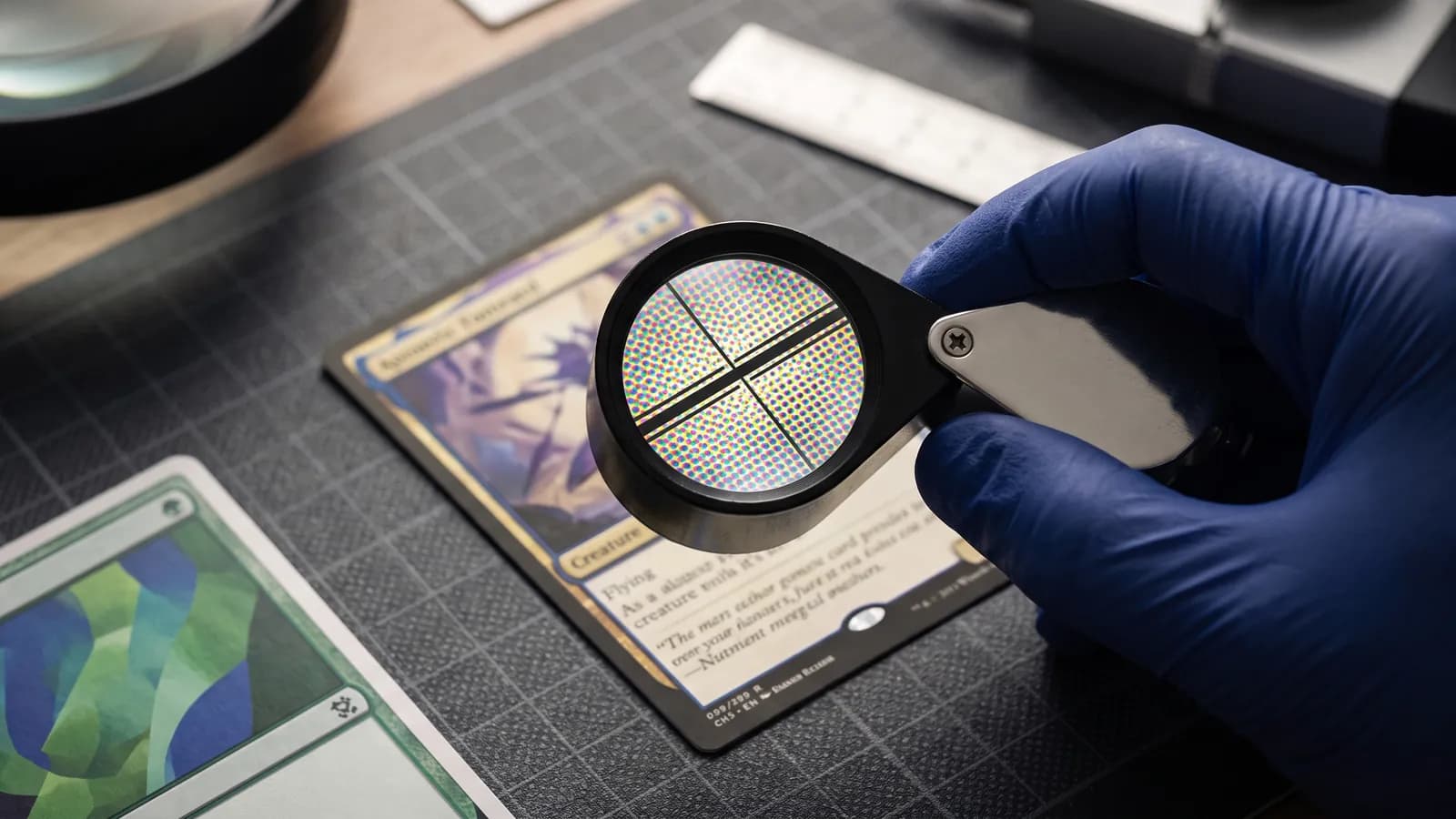
A $10 loupe and thirty seconds is almost always enough to know whether a Magic card is real. Not because loupes are magic — but because the offset printing process Cartamundi uses to produce authentic cards leaves a signature that cheap counterfeit printers simply cannot replicate. The rosette test and its companion, the black-text overprint check, are that signature. Learn to read them and you'll catch the overwhelming majority of fakes before money changes hands.
Why print pattern is so hard to fake
Genuine Magic cards are produced through commercial offset lithography — the same press technology used for high-end magazines and packaging. The process lays down cyan, magenta, yellow, and black ink in overlapping dot screens, each angled slightly differently. Where those dot screens overlap, they form tiny flower-shaped clusters called rosettes. The pattern is crisp, consistent across the card, and repeatable from print run to print run.
Most counterfeit cards are made on inkjet or consumer-grade laser printers, or on cheaper offset equipment that isn't calibrated to the same standards. Under magnification the difference is immediately obvious — if you know what real looks like.
What you need
A jeweller's loupe in the 30x to 60x range. Anything below 20x often won't resolve the dot structure clearly enough to be confident. Anything above 100x makes the field of view so small that it's harder to use, not easier. A loupe with a built-in LED helps because even light reveals the ink structure better than a harsh overhead angle. See the full guide to choosing one.
Good technique matters as much as the glass. Rest the loupe against your eye socket and bring the card to the lens rather than chasing the card with a hand-held loupe. Brace both hands. Breathe. You want to be still.
The rosette test: what you're looking for
Start on the back of the card, in a block of solid colour — the brown border area is ideal. Focus until the ink resolves into distinct dots.
On a genuine card you'll see circular rosette clusters: dots arranged in a flower-like ring, each cluster separated by a tiny gap, the whole field repeating evenly across the surface. The dots are sharp-edged. The colours — cyan, magenta, yellow, black — are distinct from one another and sit on top of the card stock cleanly.
On a fake you'll typically see one of three things:
- A regular grid of dots, perfectly square — the signature of inkjet printing, which fires dots in rows and columns rather than angled screens.
- A fuzzy blur with no clear structure, where the ink has bled or the resolution is simply too low to produce proper halftone dots.
- Dots that are rosette-shaped but the wrong size — either too large or too small — which happens when a counterfeiter uses offset equipment but at the wrong screen frequency or without the right separation angles.
None of those is what you see on a real card. If the pattern looks off in any of those ways, you're looking at a fake.
The black-text overprint: the tell that seals it
This check pairs naturally with the rosette test and uses the same loupe. Move to the text box or card name — anywhere there's solid black lettering on a coloured background.
On a genuine Magic card, the black ink is printed in a separate final pass, laid cleanly on top of the underlying colour dots. Under the loupe, you can see this: the black lines are solid and sharp, with no colour halftone dots inside them. The transition from black text to the coloured background is a clean edge.
On a fake, the black is almost always built from the same halftone dot mix as everything else — which means under magnification the "black" text is actually made of coloured dots, looking slightly fuzzy and indistinct rather than solid. Sometimes you can see magenta or cyan bleeding into the letter edges. It looks like a photocopy of text rather than printed text.
This is one of the hardest things for counterfeiters to replicate, because it requires the same two-pass printing workflow that Cartamundi uses. A single-pass printer — even a good one — cannot produce this effect.
Pair it with the light test first
The loupe tests are close-up work. Before you bring out the loupe, do the fast check: hold the card a few centimetres from a phone flashlight in a darkened room. Real Magic cards use a specialty card stock with a blue-tinted inner layer — when light shines through, you see a semi-opaque card with a faint bluish cast and the internal layer's wave pattern.
A card that glows completely or looks washed-out fails. A card that blocks all light entirely also fails — that usually means a black-core counterfeit. (Foil cards are an exception; the foil layer blocks more light naturally and makes this test unreliable for them.) See the light test guide for the full breakdown.
The light test is fast. The rosette and overprint tests are near-definitive. Run them in that order.
How to build the mental reference
The single most useful thing you can do is loupe a card you already know is real before you examine anything suspicious. Grab a bulk common from a set you opened yourself. Get comfortable with what the rosette pattern looks like. Notice the clean black overprint on the rules text. Then, when you look at a suspect card, the difference jumps out on its own.
If you only check suspect cards without that reference point, you're essentially trying to describe something without a vocabulary for it. Give yourself the vocabulary first.
When the card is expensive
For any card worth more than a casual trade, the loupe should be non-negotiable — but it shouldn't be the only thing you check. Stack it against the full detection methods: the light test, a back comparison against a known-real card, and — if you have any remaining doubt — the green dot test, which examines the four red dots inside the green symbol on the card back.
If a card passes the light test, the rosette check, and the black overprint check, and you've compared the back side-by-side with a genuine copy, you've done as much as a private buyer can reasonably do without sending it to a grading service. For Reserved List cards or anything above a few hundred euros, that last step is often worth it.
One card, two checks, thirty seconds
You don't need a lab. A basic loupe, a phone light, and a known-real card as reference covers the rosette test, the overprint test, and the light test in under a minute. Fakes that beat one of those checks almost never beat all three — which is exactly why running them together is so much more reliable than relying on any single tell.