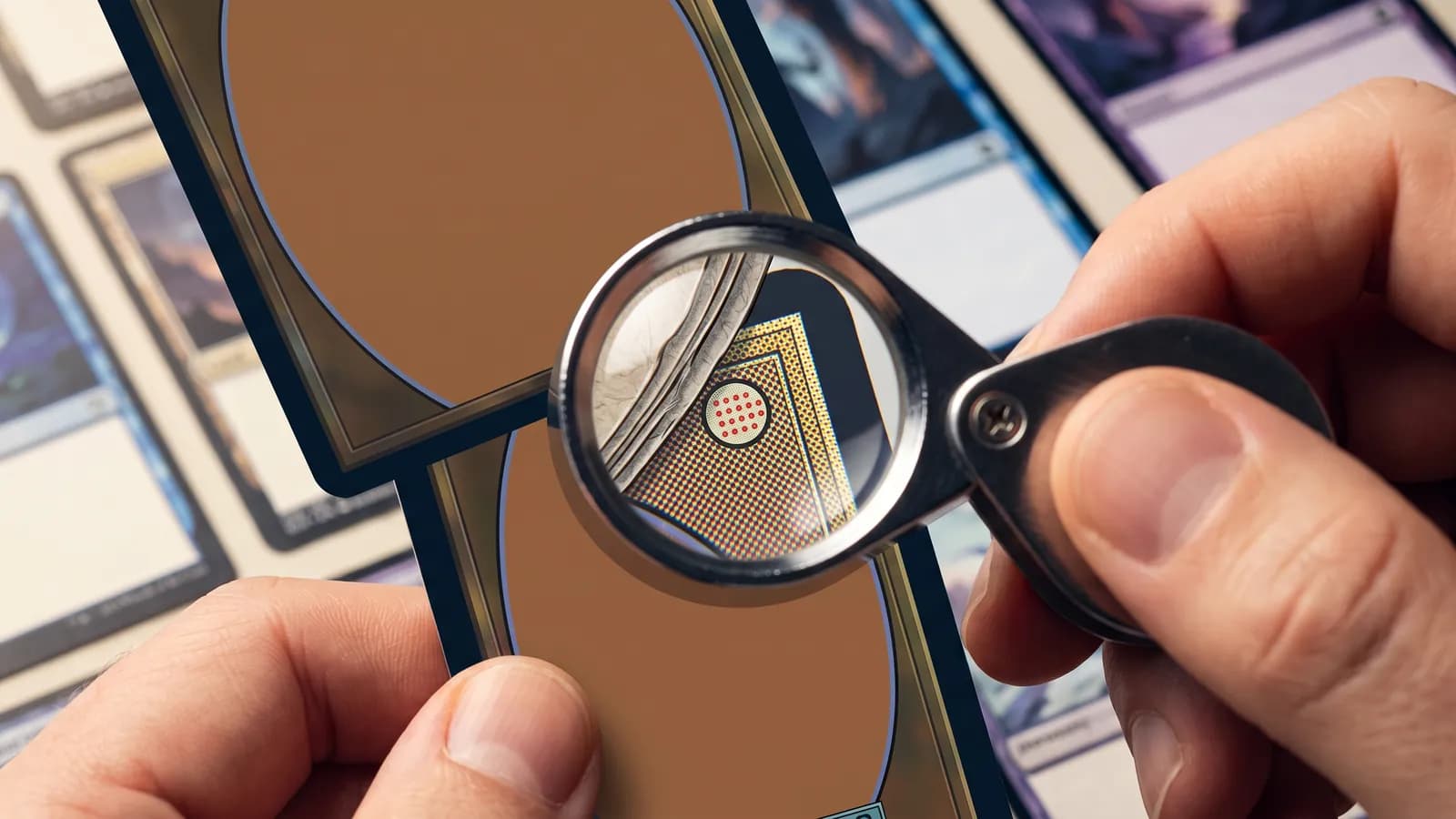
Flip a suspect card over and look at the back. Not at the artwork, not at the text — at the green circle in the centre of the oval. Under a cheap loupe, that circle hides four tiny red dots arranged in a shape counterfeiters almost never get right: an "L". That hidden L is one of the most reliable tells in MTG authentication, and the test to find it takes about thirty seconds once you know what you're looking at.
What the green circle actually is
The back of every Magic card since Alpha features a central oval with five small colour circles — one for each of Magic's five colours. These aren't decoration. They're printer registration marks: the same kind of dots that offset printing presses have used for decades to align ink layers. Wizards of the Coast has printed from the same back-design file since the original set, which means that registration pattern is identical on a Beta common from 1993 and a Commander precon from last week.
When offset printing lays down ink, it separates colour into four layers: cyan, magenta, yellow, and black (CMYK). The green you see in that circle isn't a single coat of green ink — it's cyan and yellow dots overlapping in a rosette pattern. Inside that layered green area sits a tiny yellow spot. Inside that yellow spot: four red dots, three stacked vertically with one extending to the right. An L shape. Three dots tall, one dot wide at the base.
No green on the market. No yellow. No blue. Four red dots, L-shaped.
Why fakes fail it
To replicate that L, a counterfeiter would need Wizards' original print separation files — the individual layer masks that tell each ink plate exactly where to deposit colour. Without those files, they're reverse-engineering the result, and the math of CMYK rosettes doesn't forgive approximations. Most fakes end up with one of these problems:
- No dots at all — the green is printed as a flat solid colour, which looks fine to the naked eye but fails immediately under 30x magnification.
- Green on yellow instead of yellow on green — the layer order is reversed, a tell that's instantly obvious once you know what the correct version looks like.
- Dots present, L shape wrong — the dots exist but are misaligned, the wrong size, or there are more or fewer than four.
- Smeared or blurry dots — lower-quality printing shows ink bleed that obscures the pattern entirely.
The people who print the best modern fakes are good. They get the card texture close, the foil treatment close, the back colour close. But the green dot keeps catching them because it's a consequence of a proprietary printing process, not just a design element you can copy by looking at a photo.
How to do the test
You need magnification. The naked eye can't resolve four dots inside a circle that measures a couple of millimetres across. A jeweller's loupe at 30x is the sweet spot — enough to see the L clearly, not so powerful that minor surface texture fills the whole field of view. A 20x loupe works. A 60x loupe works too, but the depth of field gets shallow and you'll be tilting the card to focus. If you're buying a loupe specifically for card inspection, 30x is the standard recommendation — see the loupe buying guide for specific models.
The test itself:
- Flip the card and locate the five colour circles in the centre oval.
- Find the green circle — it sits between the blue and the black circles in the standard back layout.
- Look through the loupe at the green circle under a bright, direct light. Natural daylight or an LED lamp both work. Avoid fluorescent overhead light that creates glare.
- Find the yellow area within the green. It reads as a lighter warm patch near the centre of the circle.
- Count the red dots in that yellow area. Four dots. L shape. Three vertical, one to the right at the bottom.
Real card: you'll see exactly this. The dots are crisp, the L is obvious once you've trained your eye on a known-good card.
Fake card: the most common result is a flat green smear with no dot structure at all, or a muddled cluster of dots that doesn't resolve into an L at any angle.
Compare against a card you know is genuine — a bulk common from a set you opened yourself works perfectly. The pattern is consistent across essentially every English-language card with a standard back.
What the green dot test doesn't catch
Two categories of fakes beat this test, and you should know both.
Re-backs. Some high-end counterfeits attach a genuine card back (sourced from a cheap bulk card) to a fake front. The back is real, so the green dot is real. These are expensive to produce and uncommon outside of very high-value targets, but they exist. Against a re-back, you check the front under magnification instead — see the rosette print test for what to look for on the face side.
Cards in sleeves or graded slabs. If the card is in an opaque sleeve, you can't perform the test without removing it. That's usually fine — ask the seller to confirm you can inspect before purchase, and be suspicious if they refuse. Graded slabs are trickier: you're trusting the grading company's process. Known companies with established track records are fine; sketchy "authentication" stickers from unknown sources are not.
Where it fits in a full inspection
The green dot test is strong, but no single test is infallible. The standard workflow most experienced buyers use runs like this:
- Light test first — hold the card to a bright LED. Genuine cards show a faint blue tint from their internal core layer. A card that blocks light completely or glows a cold white is suspicious. The light test is quick and needs no equipment.
- Green dot test second — the most specific check for the back. Catches the majority of fakes.
- Rosette print test if anything is still off — examine the front under magnification for the dot pattern that offset printing produces. Fakes using inkjet or toner printing fail this completely.
- Back comparison for colour — lay the suspect card next to a known-good card of the same era. Counterfeits often get the brown tone of the back slightly off, or the card is noticeably lighter or darker.
For most cards under fifty euros, the light test and the green dot test are enough to make a call. For expensive cards — The One Ring, Underground Sea, anything Reserved List — run the full sequence and consider a professional second opinion before completing the transaction.
The one thing most buyers skip
Training your eye takes about ten minutes. Pull five cards from a bulk box you trust, look at each green dot through a loupe, and burn the correct L shape into your memory. After that, a fake's green circle looks wrong immediately — not because you're counting dots consciously, but because the pattern is off. That ten minutes is a better investment than any app or scanner that claims to authenticate cards from a photo. The physical detail matters, and a flat image strips it out.
The green dot isn't glamorous. It's four tiny red dots that most buyers have never heard of. But it's been quietly failing counterfeits since Alpha, and the fakers still haven't solved it.