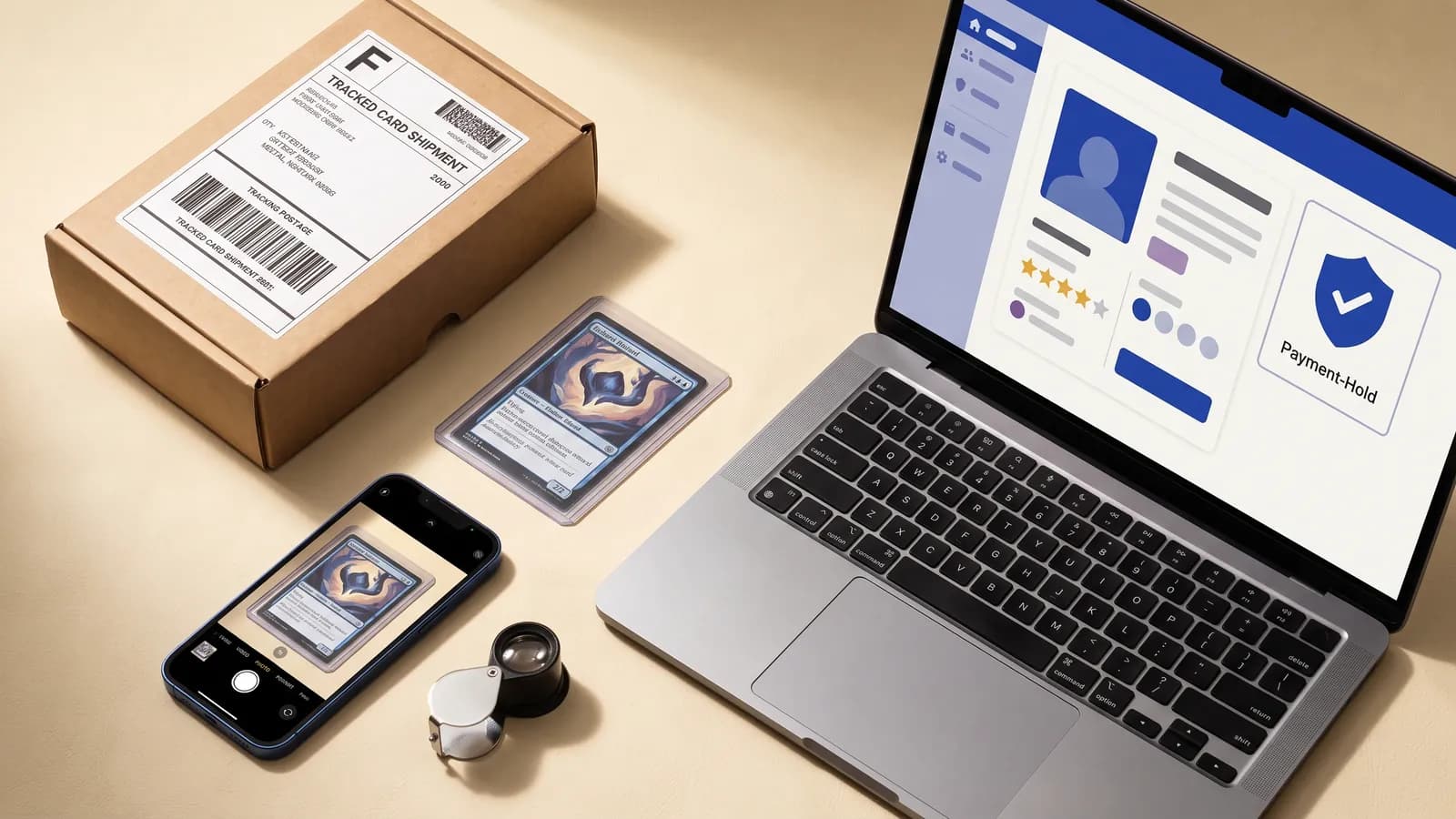
Cardmarket is a legitimate peer-to-peer marketplace, but it is not the seller of the cards listed there. Your purchase contract is with the individual seller. That distinction explains both why the platform can be safe and why no order is risk-free.
Short answer: Cardmarket is generally safe when you stay on cardmarket.com, choose a seller with a meaningful history, use tracked shipping for valuable orders, and inspect the contents before confirming arrival. Trustee Service protects the payment process on qualifying tracked orders; it is not a blanket guarantee of authenticity or card condition.
If you are choosing a listing now, use the practical 9-point seller checklist. This guide explains which protection applies after checkout and what to do when an order is late, damaged, wrong, or suspicious.
| Purchase setup | What you can rely on | Remaining risk |
|---|---|---|
| Tracked shipment with Trustee Service | Cardmarket holds payment until arrival is confirmed; tracking and the postal investigation create evidence | A lost shipment can take months to resolve; condition or authenticity still needs inspection |
| Other tracked shipment | Online delivery record and Cardmarket order history | Trustee payment hold may not apply |
| Untracked shipment | Order history and direct contact with the seller | No independent delivery scan; weaker evidence if the letter disappears |
| Payment or conversation moved off-platform | Whatever protection the external payment method offers | Cardmarket cannot reliably review an off-platform transaction; avoid it |
What the Trustee Service actually does
Cardmarket's Trustee Service is a payment hold for qualifying tracked shipments. Cardmarket keeps the purchase amount until the buyer confirms arrival. According to its new-user guide, the service is used for orders costing more than €25 and for a seller's first five sales. Other risk signals can also make registered shipping mandatory.
The fee is not merely “a fraction of a percent”: Cardmarket's current fee table lists a Trustee fee of 0.5% to 1% of the article value, depending on the shipping method. The exact checkout total is the figure that matters for a specific order.
How the normal process works
- Cardmarket collects the purchase amount and holds it in trust instead of paying the seller immediately.
- The seller ships the order with tracking. Cardmarket recommends also sending the tracking number to the buyer in an internal message.
- The buyer follows the shipment and, after delivery, checks the contents, condition, and plausibility of the cards.
- Only then does the buyer confirm arrival, after which Cardmarket releases the held payment to the seller.
A scan in the destination country is not proof of delivery. Cardmarket treats statuses such as “arrived” or “delivered” as evidence that the shipment has actually reached the recipient. If tracking does not change for more than seven days, a postal investigation should be started.
If the buyer does not confirm arrival: the 7-day case
If tracking shows successful delivery but the buyer has not confirmed after two working days, the seller should first contact them politely. If there is still no confirmation or problem report during the following three working days, the seller can contact Cardmarket support with the tracking number and shipping date.
Cardmarket then checks the shipping status and gives the buyer a 7-day deadline. If the buyer neither confirms arrival nor files a complaint during that period, Cardmarket can confirm arrival and release the payment. Trustee Service therefore does not let a buyer keep a demonstrably delivered order open indefinitely.
If the order does not arrive: the 14-day case
If the order is still missing seven days after shipment was confirmed, the buyer should first request the tracking number and check both tracking and the local post office. After more than 14 days, the action “Arrived? → NO” becomes available under “My Purchases → Sent Orders.”
That report starts Cardmarket's documented resolution process:
- Cardmarket asks the seller to provide shipment details and open a postal investigation with the carrier.
- If the seller provides no data within 14 days, Cardmarket refunds the order after the deadline.
- If an investigation was opened, Cardmarket waits for its result. If the order is delivered, the buyer can confirm it. If it returns to the seller, both sides agree on reshipping or cancellation. If the carrier declares it lost, Cardmarket refunds the buyer; the carrier's compensation initially goes to the seller.
Cardmarket warns that a postal investigation can take up to three months. Trustee Service therefore does not promise an immediate refund; its central protection is that the money is not paid to the seller while the documented investigation remains unresolved.
That is meaningful protection, but its scope matters:
- It protects the payment while a qualifying tracked shipment is unresolved.
- It only applies when Trustee Service and tracked shipping are active, not to ordinary untracked letters.
- Tracking shows what the carrier recorded; it does not authenticate a card.
- You should not confirm arrival while a damage, content, or authenticity issue is unresolved. Cardmarket says it treats a shipment as resolved once arrival is confirmed.
- It neither replaces a statutory withdrawal right nor guarantees that every condition or authenticity dispute will be decided in the buyer's favor.
Trustee Service is not the same as buyer rights
Cardmarket is the marketplace intermediary; the seller is your contractual counterparty. Cardmarket's help page for an order that arrived with a problem makes an important distinction:
- A purchase from a professional seller or Powerseller comes with the legal 14-day right of withdrawal described by Cardmarket.
- A purchase from a private seller does not have that same withdrawal right. Buyer and seller need to agree on a solution, with Cardmarket support available if they cannot.
The precise legal rights can depend on the seller, buyer, and country. Do not treat the Trustee badge as a substitute for checking whether a seller is private or professional.
Is there a minimum order value?
There is no single Cardmarket-wide minimum basket that applies to every order. Individual sellers can set a minimum order value, so a cheap card may require adding another item from that seller.
This is separate from the €25 Trustee threshold. The former is a seller's basket setting; the latter is one reason Cardmarket applies Trustee Service and registered shipping.
How to read a seller rating correctly
Do not judge a seller by the displayed percentage alone. Cardmarket calculates its seller level from the most recent 100 evaluations or the last month, whichever contains more evaluations. The official seller-rating guide currently defines these main levels:
- Outstanding: at least 36 evaluations, at least 97% “very good,” and no more than 1% neutral or bad evaluations.
- Very good: at least 36 evaluations, at least 92% “very good,” and no more than 3% neutral or bad evaluations.
- Good: at least 6 evaluations, no more than 4% neutral and 2% bad evaluations.
- New seller: fewer than 5 evaluations and no neutral or bad evaluation.
Also check the seller's total completed sales, recent written feedback, location, professional/private status, and whether the price is implausibly low. A large lifetime sales count is useful context, but it is not the data window used for the displayed seller level.
What to do when an order goes wrong
Do not use one generic “open a dispute” response for every problem. The evidence and next step depend on what happened.
A tracked order is late
- Check tracking from the Cardmarket order page.
- Use the “not arrived” action once it becomes available; for Trustee orders, Cardmarket documents this at 14 days.
- Let the seller start the carrier investigation and keep all communication on the order page.
- Do not confirm arrival just to close a notification.
If tracking says “delivered” but nothing is there, Cardmarket's postal-investigation guidance says both parties should file a claim with the postal service within one week.
An untracked order is late
Cardmarket says an untracked shipment can be marked lost after 30 days. Contact the seller through the order page first. Without tracking, neither party has an independent delivery scan, so prevention matters: choose registered shipping when the value or replaceability of the cards matters to you.
The package or cards are damaged
Photograph the unopened exterior, label, internal packaging, and cards. Keep all packaging; the carrier may need it. Contact the seller before confirming arrival. For postal damage, Cardmarket asks both buyer and seller to file carrier claims.
The contents are wrong or a card looks counterfeit
Do not confirm arrival, alter the card, or send it anywhere without instructions. Record the envelope, packing, front and back of the card, and the print details that concern you. Contact the seller through the shipment page. If the seller does not answer within five working days, or no solution is reached, Cardmarket tells buyers to contact support from that shipment.
Suspecting a counterfeit is not the same as proving one. Compare the card with a known genuine copy from the same era and set, then use more than one non-destructive check. The rosette print test, green-dot test, edge/core inspection, and a carefully controlled light test examine different signals. Printing, card stock, foils, and special treatments vary; no single home test should carry the whole conclusion.
A safer workflow for expensive cards
For a card whose loss would hurt, reduce uncertainty before and after checkout:
- Compare several listings and question a price far below the market.
- Read recent feedback and check sales history plus professional/private status.
- Require tracked shipping; verify whether Trustee Service appears at checkout.
- Keep payment and messages inside Cardmarket.
- Save the listing photos and condition description.
- Photograph the package before opening it.
- Inspect the exact printing with multiple non-destructive methods.
- Confirm arrival only after the order, condition, and authenticity look right.
For Reserved List and other high-value singles, continue with the dedicated Reserved List buying checklist.
The honest conclusion
Cardmarket provides real safeguards, particularly tracked shipping, a documented seller-rating system, an on-platform order record, and Trustee payment holding on qualifying orders. It cannot eliminate seller risk, postal loss, grading disputes, or counterfeits.
The safest answer to “Is Cardmarket safe?” is therefore conditional: yes, it can be a safe way to buy cards when the transaction stays on-platform and the shipping, seller history, and inspection effort match the value of the order. Untracked shipping and premature arrival confirmation remove two of the most useful pieces of evidence and leverage.
To recognize common marketplace tactics before buying, read the Cardmarket scam-pattern guide.
Official Cardmarket sources
- New User Guide
- Trustee Service
- Fees
- Evaluations and Seller Rating
- Shipment Arrived but There Is a Problem
- Postal Investigations
- Shipment Has Not Arrived
Sources and process reviewed on August 27, 2026. Cardmarket can change its fees and procedures; check the linked help pages and your checkout for the current terms.