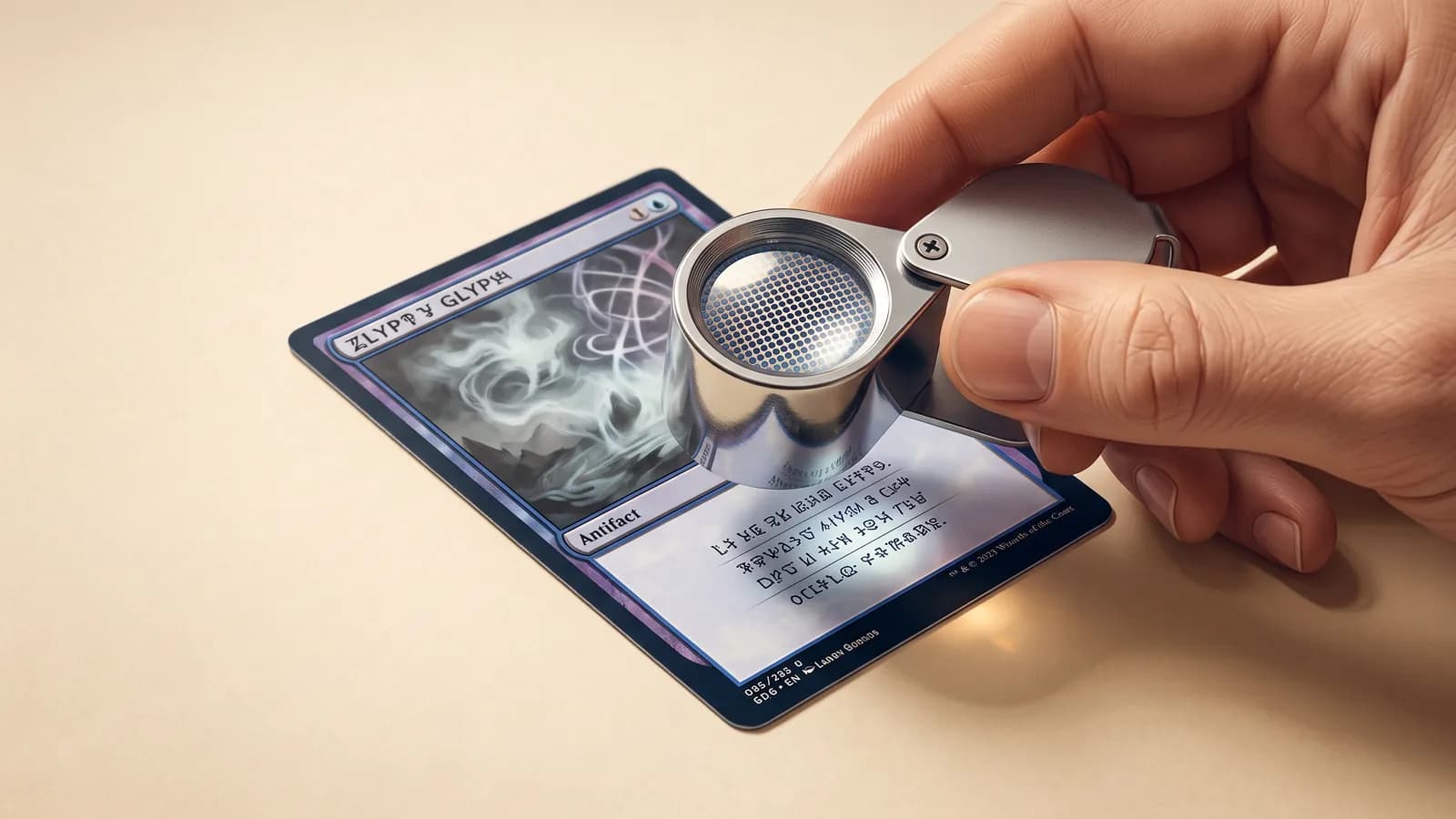
Half of the detection methods that actually catch fakes come down to one thing: looking at the print up close. You don't need a microscope or an expensive rig to do that — a cheap loupe does the job. Here's what to buy and, more importantly, how to read what you see through it.
What magnification you actually want
More zoom is not better. There's a sweet spot:
- Around 30x to 60x is ideal for cards. It's enough to resolve the printing dots clearly without the field of view getting so tiny and the focus so twitchy that you can't find anything.
- Below 20x often isn't enough to see the rosette pattern with confidence.
- Above 100x sounds impressive but is harder to use, harder to light, and shows you so little of the card at once that you lose the forest for the trees.
A basic jeweller's loupe in the 30–60x range, ideally one with a built-in LED, costs very little and is the single most useful tool for spotting fakes. See the recommended tools for specifics.
How to actually use it
Technique matters as much as the glass:
- Light it well. A built-in LED helps, but bright, even ambient light is what makes the dot pattern pop. Angle the card slightly and watch how the ink sits.
- Get close and steady. Rest the loupe against your eye socket and bring the card to the loupe, not the other way around. Brace your hands.
- Focus on a flat area of solid colour first — a border or a block of one ink — where the print pattern is easiest to read.
What you're looking for
Once you can see clearly, two tests do most of the work:
- The rosette pattern. Genuine cards are offset-printed, which leaves a tidy rosette of cyan, magenta, yellow and black dots. Many fakes are printed differently and show a regular grid, a fuzzy blur, or visible pixelation instead. This is the rosette print test.
- The green dot / colour test. On the back, the green of genuine cards resolves into distinct dots in a characteristic way that fakes struggle to reproduce. That's the green dot test.
Learn what real looks like first. Loupe a card you know is genuine, burn that pattern into your memory, and then suspicious cards will look wrong immediately. That single habit is worth more than any amount of magnification.
A loupe isn't the whole answer
Print checks are powerful but they're one layer. Pair the loupe with the no-tool checks — the light test and a back comparison — and you'll catch the overwhelming majority of fakes before you ever pay. For valuable cards, the loupe tells you when to stop and get a professional opinion rather than when to relax.
Grab a cheap loupe, practise on cards you trust, and the full method list suddenly becomes things you can actually do instead of things you read about.