June 24, 2026

The Light Test: The Single Most Reliable Way to Spot a Fake MTG Card

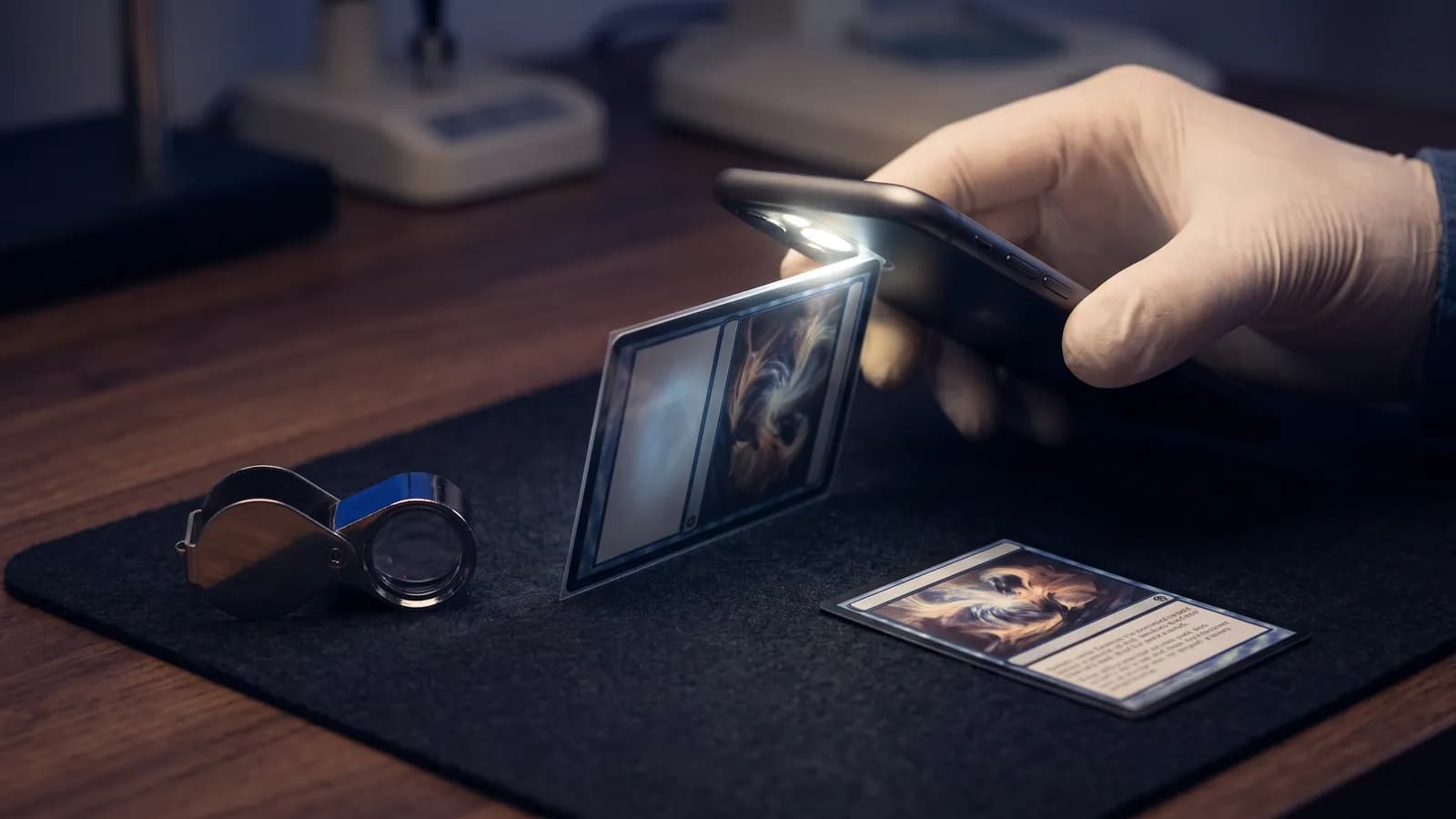
Your phone's flashlight is already the most powerful counterfeit-detection tool you own. Hold a Magic card up to it in a dark room and the card tells you almost everything — because genuine cards are built with a blue inner layer that glows in a specific, unmistakable way. Fakes, almost universally, cannot replicate it. That's the light test, and if you learn one thing about spotting counterfeits, this is the one.

Why the card stock matters

Magic cards aren't just printed paper. Wizards uses a proprietary multi-layer cardstock — commonly called Corona stock — produced by Cartamundi. Sandwiched between the white front layer and the printed back is a distinctly blue core. That core serves two purposes: it gives cards their characteristic snap and rigidity, and it prevents the card from being read through a sleeve when held up to a light.

Counterfeiters work from scans and photos. They can copy the artwork, the text box, even the mana symbols down to the pixel. What they cannot easily replicate is the physical construction of the card itself. The blue core requires the same proprietary paper Wizards sources from Cartamundi — and that isn't available to anyone running a pirate print operation.

How to do the test

You need nothing but your phone and a card. Press the flashlight directly against the back of the card and look through the front in a dim room — or just a shaded area. You can also press the light against the front and look through the back; the result is the same.

What a real card shows: A bluish, slightly rippled glow — the blue core scattering the light rather than letting it pass cleanly through. The light is muted and distinctly not white.

What a fake usually shows: One of two things. Cheap fakes are noticeably brighter — the light blazes through because there's nothing substantial to block it. Higher-effort fakes often compensate with a black inner layer, which produces a dark, dead result: almost no light comes through, and what does is grayish or brown, not blue. Neither pattern matches the genuine article.

The test takes about five seconds. It's free. And according to sources who've tracked counterfeits for years, no known fake has consistently passed this test on non-foil cards. That's a strong record.

When the test doesn't apply

The light test has two firm exceptions:

Foil cards. The metallic foil layer blocks light independently of the blue core, so foils from a genuine card and a fake may look identical under the flashlight. Don't use the light test to authenticate foils — you'll need the rosette print test and the green dot check instead.

Certain print anomalies. A handful of sets — the double-faced cards from Ixalan being the most documented example — were printed on slightly different card stock due to manufacturing changes. Some copies fail the light test despite being perfectly genuine Wizards-printed cards. If you're testing something rare and it fails, run every other check before drawing a conclusion.

Outside those two cases, if a non-foil card fails the light test, treat it as suspect until something else clears it.

What the test can't tell you alone

The light test is the fastest screen, but it's a screen, not a verdict. A card that passes is almost certainly real; a card that fails is probably fake — but "probably" isn't certainty. Combine it with at least one more check:

  • The rosette print test is the most decisive follow-up. Under a 30–60x loupe, genuine offset printing shows a neat pattern of cyan, magenta, yellow, and black dots arranged in rosettes. Counterfeits — which are almost always printed from digital scans — show a fuzzy, pixelated, or grid-like pattern instead. This test works on both foil and non-foil cards and is near-impossible to fake.
  • Back comparison. Lay the suspect card next to a card you know is real, backs facing up. Fakes consistently get the brown tone slightly wrong, the texture slightly different, or the image sharpness slightly off. Side by side, the difference is usually obvious.
  • The green dot test. Inside the green mana symbol on the card back, genuine cards show four red dots arranged in a specific pattern. Fakes almost always get this wrong — missing dots, the wrong pattern, or a spray of dots with no discernible shape.

Where the other tests fall short

People often ask about UV / blacklight testing. It works in principle — Cartamundi's paper stock fluoresces under UV light in a particular way — but the variation between sets and print runs is large enough that you need a known-genuine card from the same set as your reference. Without that, false positives and false negatives are common. A loupe costs the same as a UV torch and tells you far more.

The bend test and rip test are destructive — you're physically stressing or destroying the card. Don't do them on anything valuable. And even if a card survives a bend "correctly," you haven't proven it's genuine; you've only proven it's flexible in a similar way.

The buy-it routine

If you're buying online — TCGplayer, Cardmarket, eBay, a private seller on Discord — run the light test the moment the card arrives. Don't sleeve it first. Don't shuffle it in. TCGplayer's buyer protection requires you to report suspected counterfeits within 30 days of delivery and send the card to them for verification. Cardmarket has a dispute process too, but your window to act is finite. A card that goes into your deck is a card that's harder to return.

For purchases at a local game store or a card fair, ask to test before you pay. Any honest seller will say yes. A seller who says no is telling you something.

Before a high-value purchase

If you're looking at a Reserved List card, a serialized card, or anything where being wrong costs you real money, the light test is your first filter, not your last. Fail it and you're done. Pass it and you escalate to the loupe. If you're still uncertain, walk away or find a professional opinion — the full set of methods exists for exactly that situation.

The light test is fast, free, and has a better track record than anything else that requires no equipment at all. Start with it every time. It won't catch everything, but it catches most things — and most things is a very good place to start.