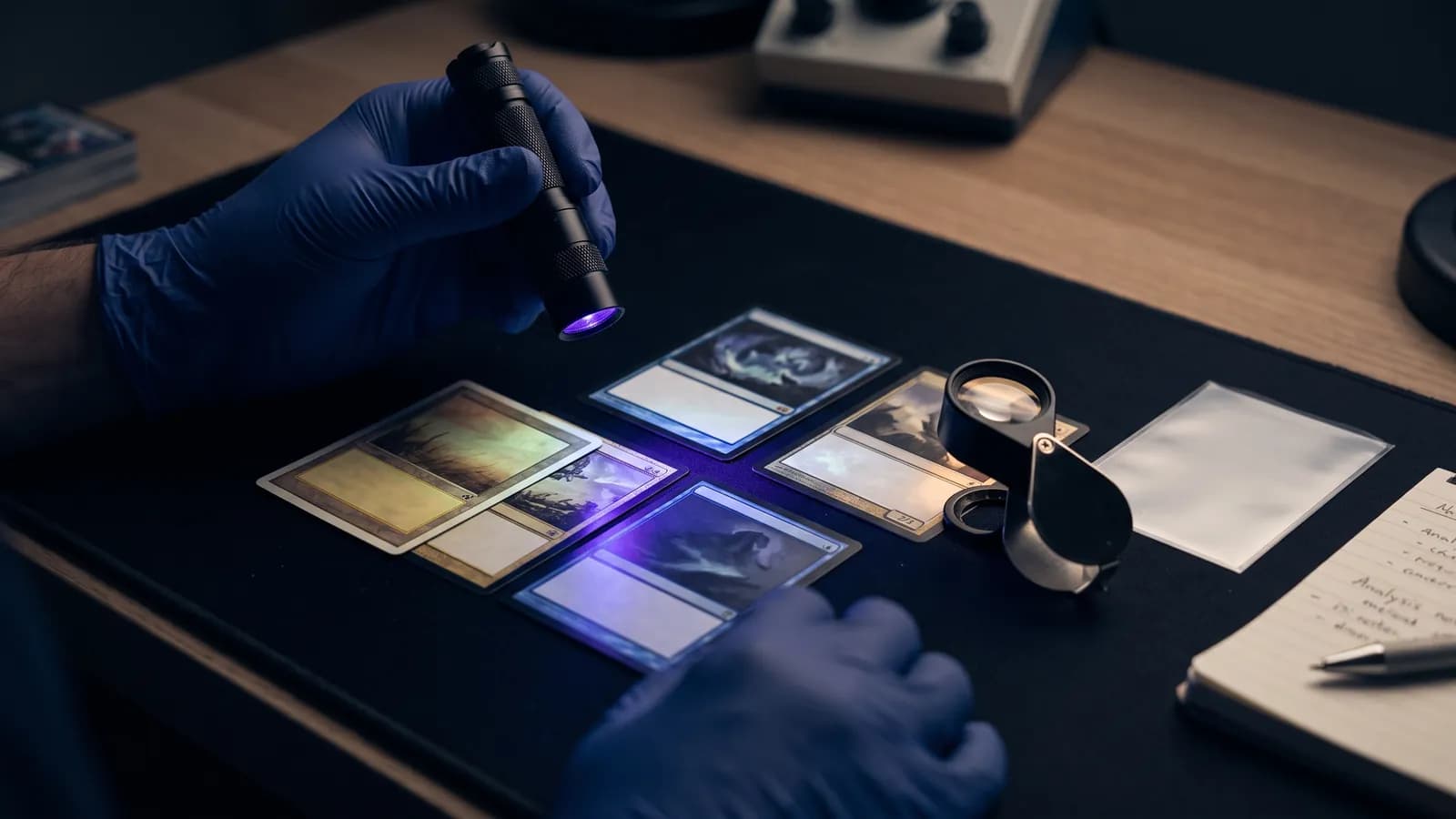
Someone probably told you to buy a UV torch for spotting fake Magic cards. It's not bad advice, exactly — but it's the kind of advice that sounds more definitive than it is. The UV blacklight test is one of the weakest tools in the authentication kit, and understanding why tells you a lot about how counterfeit detection actually works.
What the UV test is supposed to show
The idea comes from a real property of genuine Magic card stock. Cartamundi — the Belgian company that has printed Magic cards since the early 1990s — uses a proprietary paper called Corona stock. Under UV light, the optical brighteners in that paper fluoresce in a recognizable way. The theory is: real card glows right, fake card glows wrong.
That's not wrong. It's just incomplete.
Why it falls apart in practice
The fluorescence behavior of Magic cards is not consistent across sets, print runs, or even individual print batches. A card from Revised looks different under UV than a card from Modern Horizons 3. A heavily played card that's seen sunlight fades differently than a pack-fresh copy. And some legitimately authentic cards — particularly certain older editions — don't fluoresce the way you'd expect at all.
What this means practically: to use the UV test correctly, you need a known-genuine copy of the same card from the same set as your reference. Without that baseline, you don't know what "right" looks like. You're comparing the suspect card to a mental model of how Magic cards should look, and that model is unreliable.
There's a second problem: high-quality fakes have caught up. The sophisticated counterfeits circulating in 2025 and 2026 increasingly use paper stock that mimics the fluorescence behavior closely enough to pass a casual UV inspection. The test catches lazy fakes. It was never designed for anything else.
What actually works
If you're going to spend money on an authentication tool, skip the UV torch and buy a loupe. The rosette print test is as close to foolproof as this hobby gets. Under 30x or 60x magnification, genuine Magic cards — printed by offset lithography — show a clean rosette dot pattern: cyan, magenta, yellow, and black dots arranged in overlapping circles. Counterfeits are printed from digital scans using inkjet or laser equipment, and the dot pattern is completely different. It's either grid-like, pixelated, or shows no coherent pattern at all. Side by side with a genuine card under a loupe, the difference is stark enough that you won't second-guess it.
The other test that should come before UV is the light test. Press your phone flashlight against the back of the card in a dim room and look through the front. A genuine card shows a blueish, slightly rippled glow — that's the blue inner core of the Corona stock scattering the light. A fake either blazes white (cheap fakes with no blocking layer) or shows almost nothing (fakes with a black inner layer intended to mimic light-blocking behavior). This test works because of the physical construction of the card, not its surface chemistry. No known counterfeit has consistently passed it on non-foil cards.
Neither of those tests requires UV light. Together, they catch everything the UV test catches, plus a lot that it doesn't.
When UV light is actually useful
To be fair to the test: it's not useless in every context. For bulk evaluations where you're moving fast through a large collection and want a quick first pass, UV can flag obvious mismatches — particularly older, lower-effort fakes that used paper with radically different fluorescence. And for players who enjoy deep authentication research, there are documented UV fingerprints for specific sets that go beyond casual inspection.
The MM2015 caveat is worth knowing: Modern Masters 2015 cards show a brownish tint to their black areas under UV light that can look suspicious next to other sets. This is a genuine printing quirk, not a sign of a fake. If you're testing older cards alongside newer ones, the variation you see may not mean anything.
So the test has its place. It's just not the place most people assign it.
The tests that destroy the card
A quick word on what not to do. The rip test — physically tearing the card to check for the blue core — is definitively accurate, and definitively something you should only ever do on a bulk common you don't care about. The bend test tells you something about card flexibility but nothing that couldn't be faked, and stressing a card repeatedly over its spine damages it. Don't run either of these on anything valuable.
Buying online and what to check first
If you're buying off Cardmarket, TCGplayer, or eBay, you're essentially buying on trust until the card arrives. The moment it does, don't sleeve it first. Run the light test and, if the purchase was at all significant, follow up with a loupe check. TCGplayer gives you 30 days to report a suspected counterfeit; Cardmarket's dispute process has its own window. Act within those windows or you lose your recourse. More on the marketplace patterns to watch for.
For reserved list cards or anything expensive, treat the light test as a filter, not a verdict — and have a loupe ready for anything that passes. An underground sea that passes the light test but shows a pixelated dot pattern under a loupe is still a fake. See the full detection methods for the complete inspection sequence.
The honest summary
The UV blacklight test is one of the more popular pieces of advice in Magic authentication because UV torches are cheap, the test looks impressive, and it genuinely does catch some fakes. But its limitations are real: it requires a same-set reference card to be meaningful, its results vary across print runs, and the best current counterfeits have largely addressed the fluorescence gap.
The light test and the rosette loupe test are faster, cheaper to set up properly, and catch more fakes — including the sophisticated ones. If you already own a UV torch, it doesn't hurt to include it in your inspection routine. But if you're choosing where to spend five euros, spend it on a loupe.