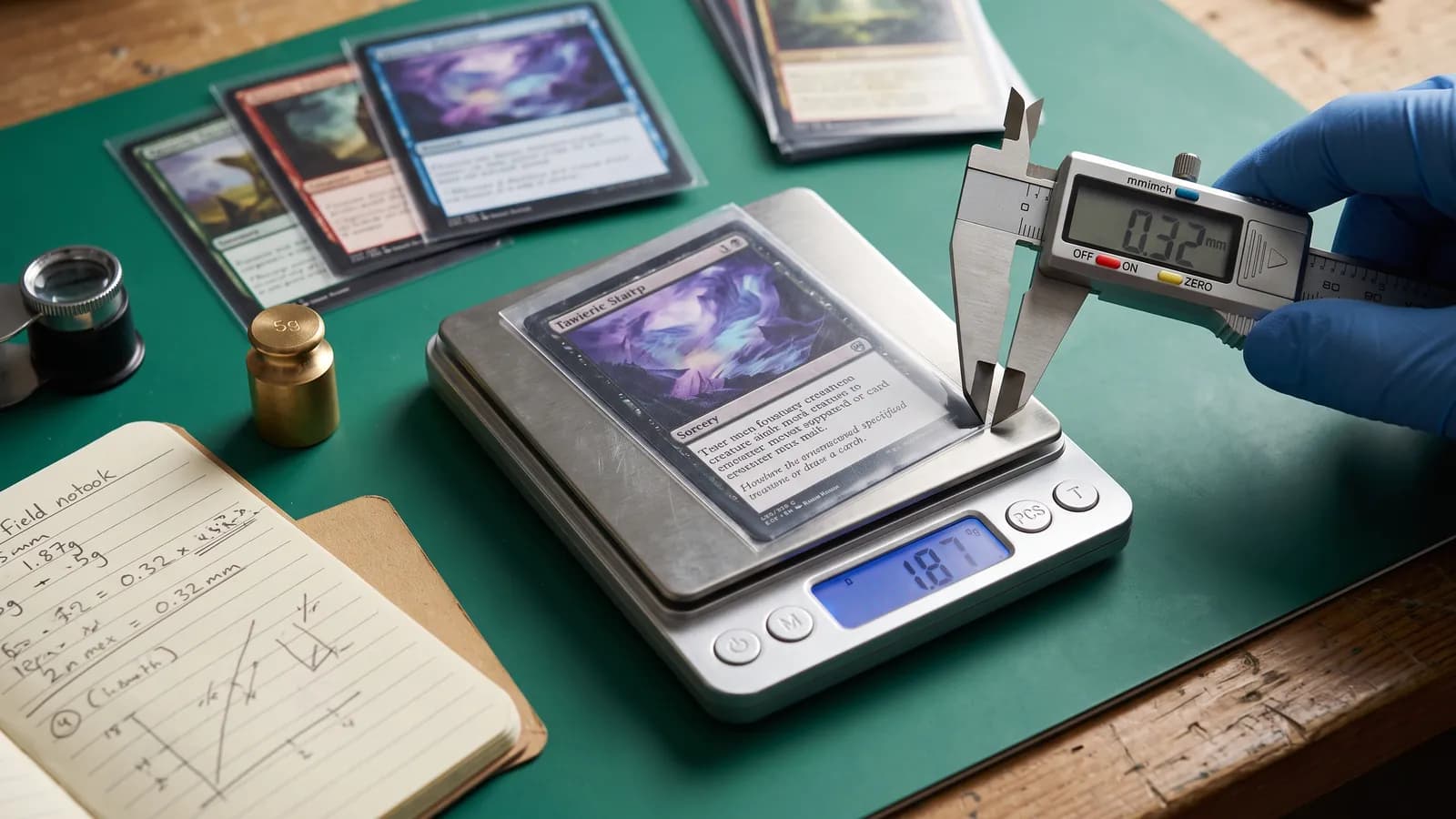
Weight is supporting evidence, not an authenticity threshold. Compare the suspect card with genuine copies of the same printing and finish. A reading such as 1.75 g or 1.9 g does not by itself establish real or fake.
How much does a genuine Magic card weigh?
There is no single weight range that authenticates all Magic cards. Wizards documents multiple genuine stock constructions and natural paper variation in Playing Card Board. Build a comparison range from suitable reference cards instead of applying a universal 1.78 g ceiling.
Keep finishes separate: compare non-foil with non-foil and the same foil treatment with itself. An extra layer changes the comparison; it does not supply a universal foil weight.
What do fake cards weigh?
This guide has no representative dataset showing what most counterfeits weigh. A weight difference does not identify a card's country of manufacture or chemical composition.
A scale with 0.01 g display resolution can show small differences, but resolution and measurement accuracy are not the same thing.
A reback can have an unusual weight because card parts have been combined. A matching weight does not exclude one.
The scale you actually need
Use a scale that resolves small differences, typically a 0.01 g display. Check its accuracy specification, calibration procedure, and repeatability; extra displayed digits do not guarantee accurate results.
Do not buy a scale that only shows one decimal place. A reading of "1.9g" when the true value is 1.89g or 1.94g is not useful.
The right way to use the weight test
Use comparison, not an absolute verdict. Calibrate and zero the scale, remove sleeves and holders, and weigh several genuine references of the same set and finish. Repeat readings under the same conditions.
Without a suitable reference, record the weight but leave the authenticity result inconclusive. Do not substitute a universal 1.78 g or 1.9 g cutoff.
Storage and condition can affect a comparison. Do not apply an unsupported fixed humidity correction; compare cards under the same conditions without drying or heating them.
Where weight fits in the inspection order
The weight test is fast, cheap, and non-destructive. Those are its main virtues. Its limitation is that it can't catch every fake — well-made counterfeits using better cardstock occasionally land within the genuine range — and it says nothing definitive about cards that pass.
Think of it as a triage tool rather than a verdict:
- Outside the reference range: recheck calibration, finish, and conditions, then investigate the mismatch.
- Within range: still inspect both printed faces; similar mass is not proof.
- Results disagree: preserve the card and seek another opinion. A light comparison adds evidence, not a final verdict.
Do not rip, bend, wet, or otherwise damage the card. Destructive tests can leave both damage and uncertainty.
What the weight test misses
A counterfeit can overlap the genuine comparison range. This guide does not claim a measured detection rate for the weight test.
There is also a category of genuine cards that fall slightly outside the expected range due to printing variation or environmental exposure. Old cards that have lived through decades of different humidity levels may have shed or gained a tiny fraction of a gram. Don't condemn a card on weight alone.
Putting it all together
Use weight alongside version, print, and construction checks. Their limitations overlap; they do not form a sequence that automatically closes every remaining gap.
If important details remain unresolved on a valuable card, an experienced in-person assessment is more useful than treating a number as a certificate.
If you want a full picture of every method and how they stack up, the methods overview covers them all in one place.