July 15, 2026

Is the Rip Test Real? Why You Should Never Rip-Test a Card

Someone at your local game store tears a card in half to prove it's fake. Everyone around the table nods like that just settled something. It didn't. The rip test is the most dramatic thing you can do to a Magic card, and one of the least useful — especially when the card you're testing might be worth real money.

What the rip test is actually checking

When you rip a card apart and look at the cross-section, you're looking for a blue layer inside the card stock. Genuine Magic cards are printed on a proprietary paper called Corona, manufactured by Cartamundi. That paper has a blue-tinted inner core sandwiched between the two printed faces. Counterfeits are usually printed on white or black core paper, so the thinking is: rip it, look at the middle, and the color tells you the truth.

The logic is sound in principle. The execution is the problem.

Three reasons to put the card down

First, it destroys the card. This is the obvious one, but it's worth saying plainly: the moment you tear a card in half, it's gone. If you're testing a card you suspect is fake and it turns out to be real, you've just destroyed a genuine card. If it was a $5 card, that's annoying. If it was an Underground Sea or a The One Ring, that's potentially catastrophic. The rip test gives you information you can get other ways — but it charges you the card's life to do it.

Second, the result is less definitive than it looks. Real Magic cards have been found with non-blue cores. They're rare, but Wizards has had quality-control variations across print runs, and some genuine cards from specific sets do not match the expected cross-section. If you rip a card and find a black core, you have not proven it's fake — you've created destruction and uncertainty simultaneously. Going the other way: modern counterfeiters know what the community looks for. High-quality fakes are increasingly printed on paper that mimics the genuine stock more closely. A blue core in a ripped card is encouraging, but it is not a guarantee.

Third, you can't do it in the moment that matters most. The rip test is useless as a pre-purchase check — no seller will let you tear their card in half to verify it. By the time you have the card in hand and full permission to destroy it, you could run half a dozen non-destructive tests that are more reliable anyway.

What to do instead

The tests that actually hold up are quick, cheap, and leave the card intact.

The light test is your first move for any non-foil card. Press a bright phone flashlight flat against the back and look through from the front in a dimly lit area. A genuine card glows with a subtle blueish wave. Fakes either block light almost completely or let it blaze through white with no blue tint — both are immediate tells. Full details at the light test guide.

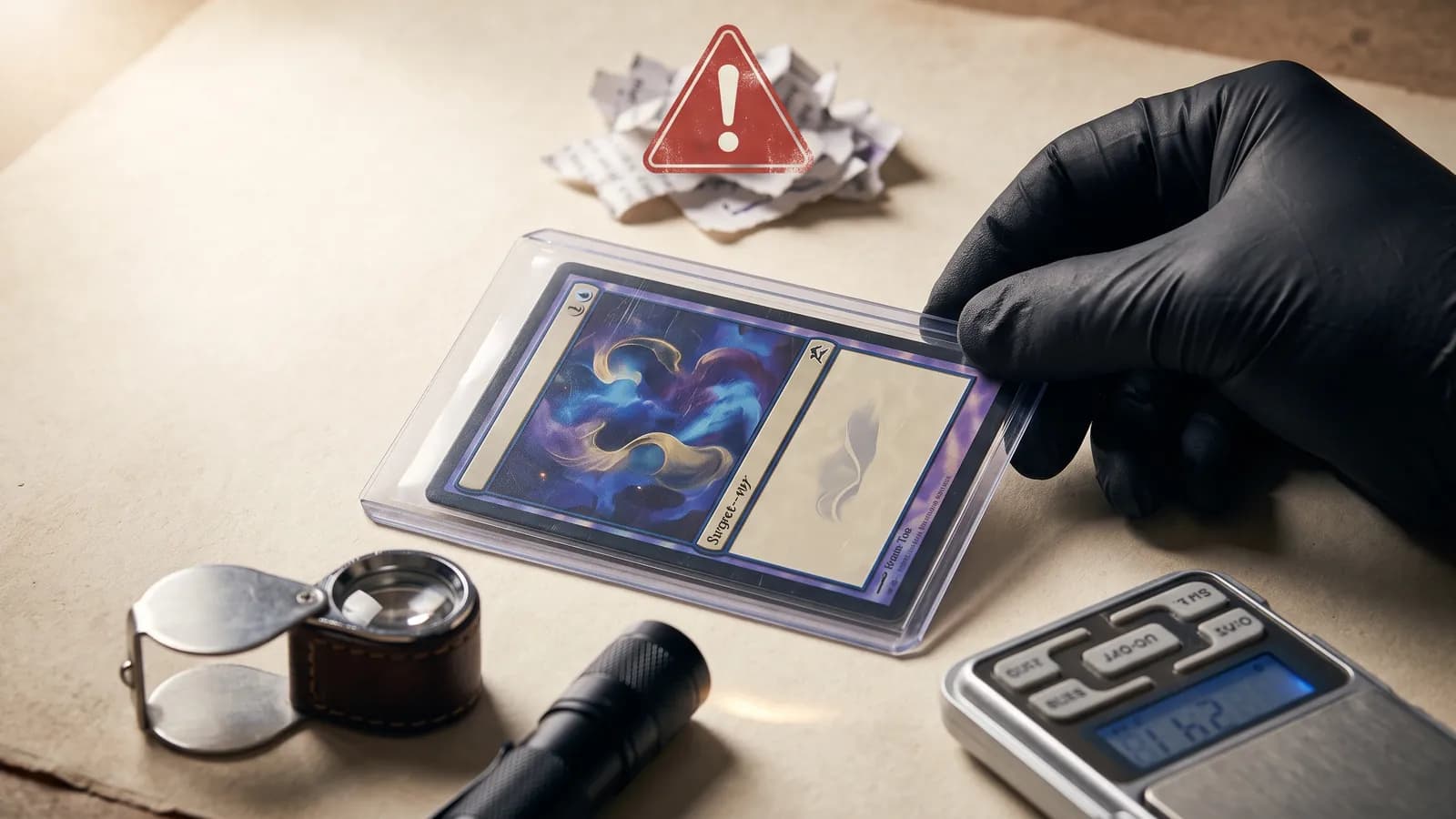
The rosette print test is the one that's close to foolproof. Get a jeweler's loupe — 30x or better — and look at the colored portions of the card. Real Magic cards are printed with an offset press, which produces interlocking rings of colored dots called rosettes. Black ink — the card name, rules text, mana symbols — sits as a solid, clean layer on top of those rosettes. Counterfeits are made from scans and reproduced on different equipment: under magnification the colored areas show a grid or blurry blob, and the black text is made from the same muddy mix of dots as the background rather than clean overprinted ink. A fake that passes the light test almost always fails this one. The full rosette print test guide has comparison examples.

The bend test is also not recommended, for similar reasons to the rip test: it risks damaging the card and the result depends too much on humidity, card age, and how many sleeves the card has lived in.

The pattern here

Destructive tests feel conclusive because they feel drastic. Tearing something in half is a commitment — surely you'd only do that if you were sure? But the rip test became popular in an era when fakes were simpler and the community had fewer tools. Now it's a habit that the internet keeps passing down even though the detection methods have moved on.

The community wisdom version of the rip test is: "if you have a bulk common you don't care about, you can tear it as a last-resort confirmation." That's technically true. The problem is that advice has a way of being applied to cards that aren't bulk commons, by people who are a little too confident they already know the answer.

The cards where this really matters

Counterfeit pressure lands hardest on Reserved List cards — the Volcanic Islands, the Tropical Islands, the Ancestral Recalls — because they're expensive, frequently traded, and can't be reprinted. A convincing fake of any of those cards destroys real value when it circulates undetected. The rip test is especially tempting with high-value cards because the stakes feel high and you want certainty. That's exactly when you need to step back and run the light test and the loupe instead. Ripping a genuine Dual Land in half to confirm it's real is not a scenario you want to live through.

If non-destructive tests leave you genuinely uncertain about a high-value card, the right move is a professional authentication service, not escalating to a more violent DIY method.

The short answer for next time

If someone at the table produces a card and someone else says "rip it to check," the right response is: hold it to a light, then put a loupe on it. You'll know more, you'll know it faster, and you won't be explaining to anyone why there's a pile of cardboard confetti where a card used to be.

The rip test is real in the sense that it checks something real. It's just not worth the cost — and it isn't necessary. The methods page covers every non-destructive check in order of how much they tell you.