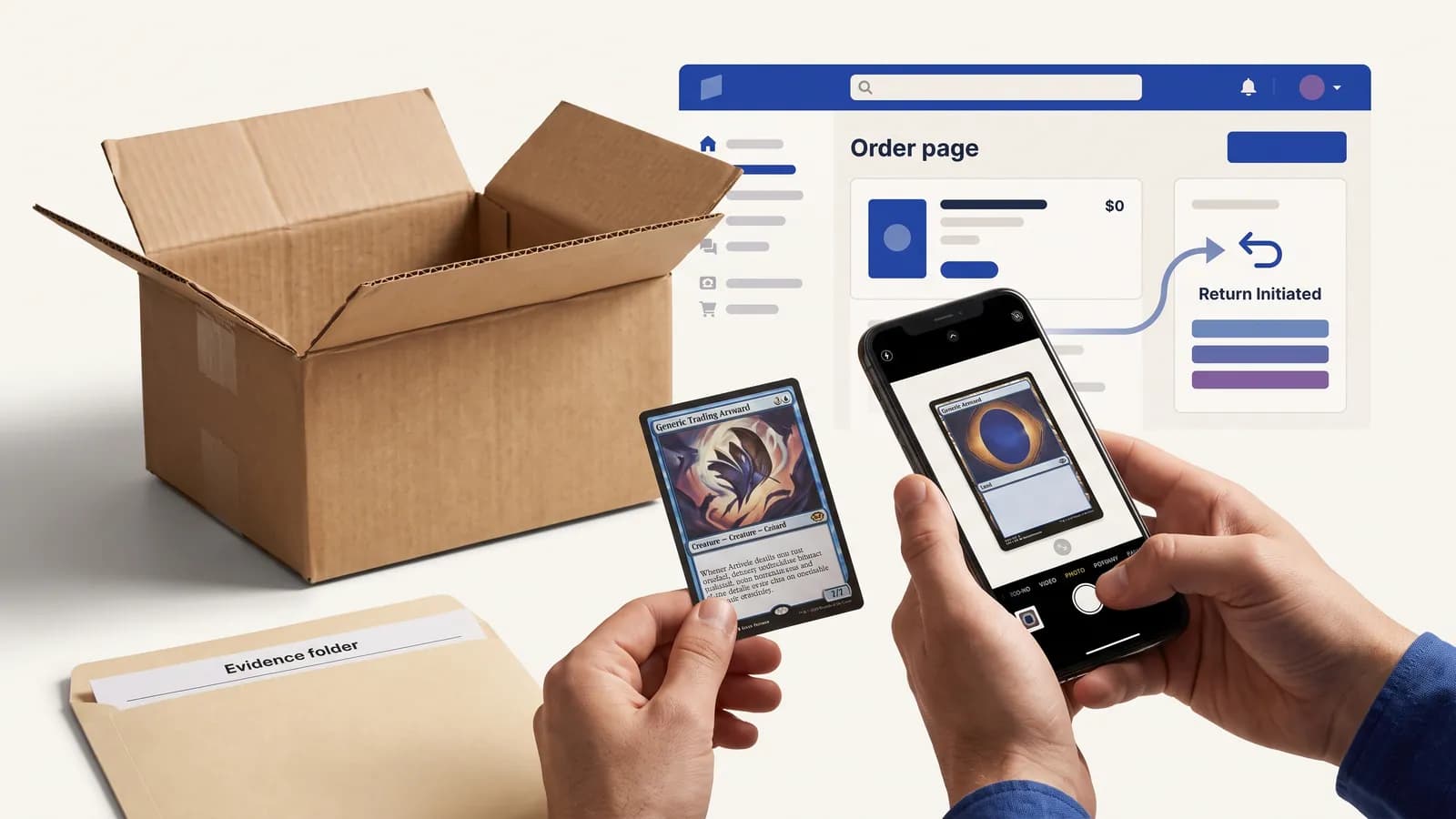
If an eBay order contains a suspected counterfeit or a card that materially differs from the listing, open the return request immediately, choose the reason that the item does not match the description or photos, preserve the card, and attach clear evidence. A seller's “no returns” setting does not by itself remove eBay Money Back Guarantee coverage for an eligible item that is counterfeit or significantly not as described.
The exact deadline and protection depend on the eBay site, the listing's return terms, and whether Authenticity Guarantee handled the card. This guide separates those cases instead of treating every eBay purchase as if it had the same three-day rule.
| Purchase | First action | Deadline to check |
|---|---|---|
| Ordinary trading card on eBay.com | Open a return from Purchase History and select the accurate “doesn't match” reason | If the seller does not offer returns, eBay.com currently requires the request within 3 calendar days after the estimated or actual delivery date; if returns are offered, use the seller's stated window |
| Card handled by eBay.com Authenticity Guarantee | Follow the return options shown for the authenticated order | Some authenticated trading-card purchases are final sale; coverage and return eligibility depend on the listing and the reason |
| Purchase on another eBay country site | Use that site's order page and local Money Back Guarantee policy | Do not import the eBay.com deadline; follow the date shown in the local order flow |
Step 1: preserve the card and document the mismatch
Do not bend, rip, mark, clean, or otherwise alter a suspicious card. Photograph:
- the front and back in even, neutral light;
- the exact defect or printing feature that differs from the listing;
- the package and shipping label;
- the listing title, description, condition, photos, and seller name;
- the order page and delivery date.
If authenticity is the concern, compare several non-destructive signals rather than treating one home test as a verdict. A known-genuine card from the same era and printing is the best comparison. Our counterfeit-detection methods explain the light test, rosette print test, and other checks — including their limitations.
Use factual language. “The received card differs from the listing in these specific ways” is more useful than asserting intent you cannot prove. eBay needs evidence about the item, not a theory about the seller.
Step 2: open the correct return request
From Purchase History, open the order and start a return. Select the option that says the item does not match the listing or photos when that is what happened. Do not choose a change-of-mind reason for a counterfeit, wrong edition, undisclosed crease, or other material mismatch.
Upload the clearest photos and give a short chronology:
- what the listing promised;
- what arrived;
- the visible or measurable difference;
- the resolution you are requesting.
Keep all communication and files inside eBay. If the seller offers an off-platform refund, asks you to close the case first, or sends a return address that conflicts with eBay's instructions, pause and use the official case flow.
The governing reference is eBay's current Money Back Guarantee policy, not an old forum post or a seller's interpretation.
Step 3: follow the return instruction eBay gives you
Do not assume that every suspected counterfeit must be returned to the seller, or that none ever are. eBay's policy says a buyer may not be required to return an item when there are strong indicators that it is counterfeit. The buyer must still open the return request and cooperate with eBay's instructions.
- A misdescribed genuine card can normally be returned through the authorized route.
- A suspected counterfeit should not be sent elsewhere, destroyed, or resold unless eBay explicitly instructs you what to do.
- An item processed by Authenticity Guarantee may need to go back through the authentication facility for reinspection.
Keep the tracking receipt if eBay authorizes a return. Do not improvise a method that cannot prove delivery.
When can eBay step in?
Give the seller the response period shown in the case. If the seller does not respond, does not provide the required return method, or the two of you cannot resolve the issue, use Ask eBay to step in as soon as it becomes available. The case page is the authoritative place for the next date and action.
Do not open a separate payment-provider dispute while the eBay case is active. Parallel disputes can interrupt the marketplace process. If eBay closes the case without resolving it, review the appeal or payment-provider options shown for that transaction; their deadlines depend on provider and jurisdiction.
What Authenticity Guarantee changes on eBay.com
On eBay.com, eligible single trading cards priced or sold at $250 or more are routed through a third-party authenticator before reaching the buyer. Eligibility also depends on card type, seller and buyer location, shipping address, and listing format. The badge on the listing — not price alone — confirms that a specific card participates.
If the authenticator cannot verify the card or finds a material mismatch, the card is returned to the seller and the buyer is refunded before delivery. Once a card has passed authentication, some purchases are treated as final sale, with narrower return coverage. Read the listing and the current trading-card Authenticity Guarantee terms before assuming that an ordinary marketplace return applies.
Match the evidence to the problem
- Suspected counterfeit: show multiple print or construction discrepancies; preserve the card for eBay's instructions.
- Wrong condition: compare wear, crease, ink, or surface damage with the condition and photos in the listing.
- Wrong printing or language: photograph the set code, collector number, language, border, finish, and other identifying details.
- Wrong card or quantity: photograph the entire package contents before separating or sleeving them.
For an expensive Reserved List purchase, use the high-value card buying checklist before checkout. If you are comparing marketplaces, see the TCGplayer Safeguard guide and the explanation of Cardmarket Trustee Service and buyer protection.
The practical answer
Act promptly, preserve the item, use the correct return reason, and let eBay's case flow determine whether the card must be returned or disposed of. The strongest case clearly connects the listing, the received card, the documented discrepancy, and the policy that applies to that exact order.
Official eBay sources
- eBay Money Back Guarantee policy
- Authenticity Guarantee eligibility for trading cards
- Buying with Authenticity Guarantee
Policy and sources reviewed on August 23, 2026. eBay rules vary by country site and can change; the deadline and return instruction shown on the individual order take precedence.