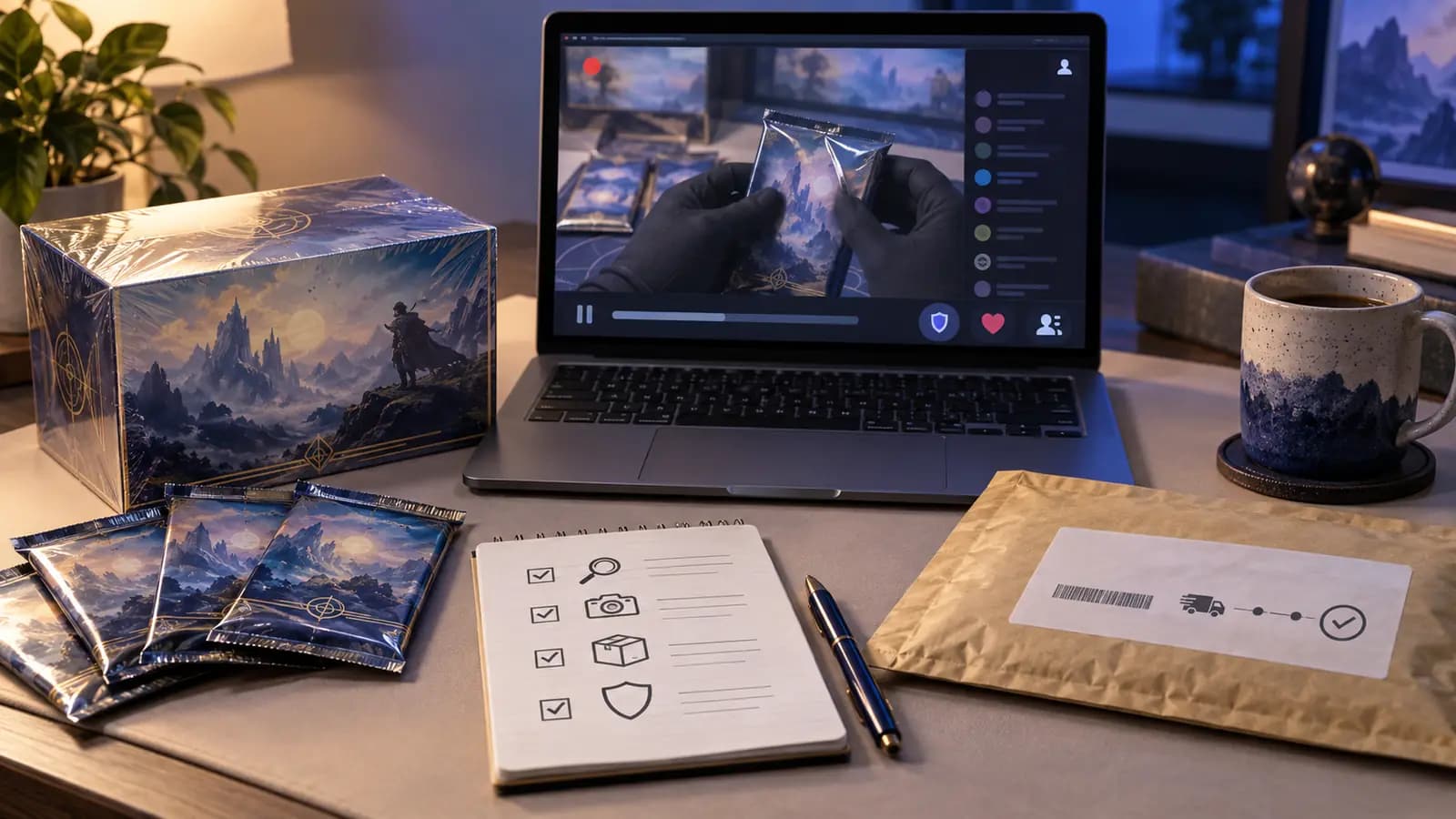
Card breaks on Whatnot look like a good deal until they aren't. You buy a spot in a live stream, watch someone crack packs on camera, and wait for a rare or a chase foil to land in your slot. When it works honestly, it's fun. When it doesn't, you've handed money to someone who either skimmed the best pulls before going live, opened resealed packs full of bulk, or simply never shipped your cards. None of this is rare — it's endemic enough that Whatnot has rewritten its card-break rules multiple times since 2024.
How a break actually works
A Whatnot card break is a live-stream sale where one seller opens sealed MTG product on camera and distributes the cards to buyers who purchased spots beforehand. The two most common formats are spot breaks, where each buyer gets one or more pack's worth of cards, and team breaks or color breaks, where buyers buy into a randomized allocation and receive every card of their assigned color or faction from the entire box. Spots are sold in the stream chat or through the auction interface, and randomization — when it's honest — happens live via an on-screen wheel.
The appeal is obvious: you can get into a Collector Booster box experience for a fraction of the box price, and there's a social dimension to watching the pulls happen in real time. The risk is that all of this depends completely on the seller's integrity.
The resealed-pack problem
The most straightforward scam is the one you're probably already thinking of: a seller pulls the box's best packs out ahead of time, reseals them with a heat gun, and opens them on stream with a convincing "nothing there" shrug. You pay break prices for product that was gutted before the camera turned on.
Resealed packs are harder to spot on a stream than in your hands, but the signs are there if the seller holds them up. Legitimate factory seals have a distinctive tight crinkle pattern at both ends — the foil is heat-fused in a consistent way that a home heat sealer can't quite replicate. Reseal attempts often leave a slightly glossier or yellower stripe along the crimp, and the foil around the pack's edges can look marginally looser or more uneven. Weight variation is another tell: a resealed pack from which a mythic has been swapped out for a bulk rare will sometimes weigh a bit less than the others, though modern scales are needed to catch small differences.
On a stream, you can't weigh the packs or feel the seals — so your real protection is the seller's track record, not your ability to spot tampering at 1080p.
Bad breaks: what "bad-break" fraud looks like
Resealing is the dramatic version. The subtler and arguably more common version is a bad break — where the seller runs a legitimately unsealed product but has already identified the hot packs.
Modern MTG set boosters and collector boosters are not weight-mapped in any reliable way, so this isn't always possible. But with older product, or with sets where experienced breakers have learned pack-weight patterns, pre-identifying valuable packs and pulling them out before the live break is straightforward. You get the break. They keep the money shot.
Then there's shill bidding: fake accounts — sometimes run by people in the same room — bidding up spots to inflate the apparent value of a break. Regulations on this are essentially non-existent, and Whatnot's own policies acknowledge that external enforcement of randomization is limited to what they can verify on stream.
What Whatnot's policies actually cover
Whatnot does have a formal Card Breaks Policy and a Buyer Protection Policy, and they're worth understanding precisely because their limits matter more than their promises.
What Whatnot says it covers:
- Items that are materially not as described (a resealed pack is a legitimate claim here)
- High-value cards that were pulled on stream but never shipped to the buyer
- Orders that were never shipped at all
What Whatnot does not cover:
- Your disappointment at the pulls — bad luck is not a claimable dispute
- Disputes filed outside the claim window (check current policy for the exact timeframe; it changes)
- Deals arranged off-platform, which voids all protection automatically
- The difference between "I think those packs were cherry-picked" and "I can prove they were" — suspicion without evidence is difficult to escalate
If you have a legitimate dispute, the process requires you to file through the app, within the window, with whatever documentation you can gather. Screenshots of the stream are your friend. Video clips are better.
Red flags to watch for before you buy
Most Whatnot MTG break scams are entirely predictable from the seller's profile if you look at it critically.
- New account, big product. A seller with fewer than a hundred sales running a break of expensive Collector Booster cases is a higher risk than an established seller with years of reviews. Check when the account was created.
- Refusal to weigh packs on camera. Some reputable breakers will weigh individual packs at the start of a break to demonstrate uniformity. Resistance to this, or defensiveness when a chat member asks, is a signal.
- Suspicious pack order. Watch whether the seller opens packs in a random sequence or tends to save certain positions. Experienced viewers have caught sellers consistently holding back the last few packs of a box.
- Unusually cheap spots. If a break's math doesn't add up — the slot prices don't come close to covering the cost of the product at retail — either the seller is operating at a loss (unlikely) or the product has already been worked.
- No camera on the sealed product before opening. A legitimate break typically shows the sealed box on camera before anything is opened. If the stream cuts in with packs already loose on the table, ask why.
- Off-platform contact. If a seller asks you to move the conversation to Discord or pay via Venmo, you lose all buyer protection. Don't do it.
Checking cards that actually arrive
If your break spot does produce cards and they arrive — whether from a break, a singles listing, or a sealed product purchase — inspect them. Counterfeits circulate through break shipping just as they do through any other MTG channel, and a resealed pack might contain a fake rare placed to look like a real one.
The two most reliable non-destructive checks are the light test and the rosette print test. Hold the card to a bright light: a genuine Magic card has a black inner core that blocks most light. Under a loupe at 10x or higher, genuine cards show the offset rosette dot pattern of commercial printing — fakes typically show blurry, irregular, or inkjet-style dots. Neither test is destructive, both take under a minute, and together they catch the vast majority of counterfeits. More detail on both is in the counterfeit detection guides.
What to do if you've been scammed
First, stop. Don't confirm receipt of the order if the items haven't arrived or are wrong. Confirming receipt on Whatnot is often the trigger that releases payment — once you confirm, your leverage drops sharply.
Document everything: stream recordings, chat logs, photos of what arrived (or didn't), screenshots of the original listing. File the dispute through Whatnot's in-app process as quickly as possible and reference the specific policy that applies. If Whatnot doesn't resolve it to your satisfaction and the amount is large enough to matter, your credit card's chargeback process or PayPal's buyer protection (if you used PayPal) are fallback options — though Whatnot transactions are increasingly direct-to-card and bypassing PayPal.
For cards purchased outside of breaks — as singles from listings — TCGplayer's Fraud Protection Policy covers counterfeit claims and has historically been responsive, requiring buyers to report within 30 days of estimated delivery.
The honest assessment
Whatnot MTG breaks are not inherently a scam. Plenty of reputable sellers run genuinely fair breaks and have the review history to prove it. The problem is that the format structurally trusts the seller completely — you're watching a stream, not standing next to them. That information asymmetry is exactly what bad actors exploit.
Do your homework on the seller before you buy. Watch a few of their streams before putting money in. Stick to established accounts with real review histories. And if anything in a break feels off — price math that doesn't work, packs that appear pre-sorted, a seller who gets defensive about basic transparency questions — walk away. There's no shortage of breaks, and there's no prize for staying in one that smells wrong.
If you're also trying to sort out whether a deck you're building belongs in a Whatnot haul or a more competitive setting, run the list through the deck analyzer before you go hunting for staples.