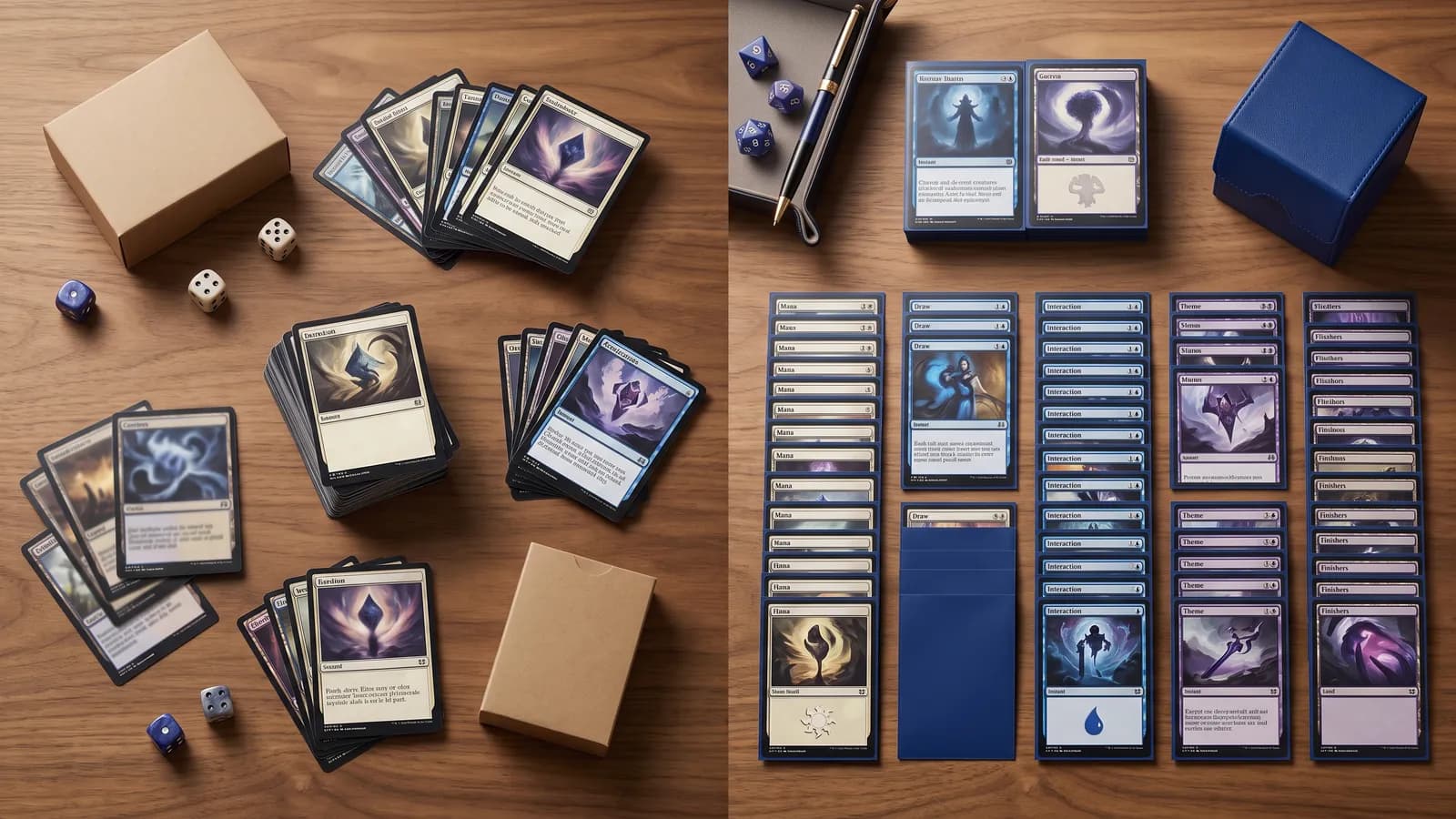
A preconstructed Commander deck is not automatically Bracket 2 (Core). Wizards explicitly decoupled precons from Bracket 2 in October 2025 because stock decks vary in power and can contain cards that do not fit the bracket. Check the starting list first. If it matches Bracket 2, you can make it more reliable without changing the kind of game it is meant to play.
Short answer: First confirm that the stock list has no Game Changers and fits the Bracket 2 play pattern. Then upgrade consistency before power: improve the mana curve, replace off-theme cards, balance ramp, card draw, and removal, and keep Game Changers, early two-card infinite combos, mass land denial, and dense fast mana out. Recheck the finished list rather than relying on the word “precon.”
| Upgrade | Usually stays in Bracket 2 | Warning sign |
|---|---|---|
| Starting list | No Game Changers; incremental, visible game plan | The sealed list already contains a Game Changer or plays above Core intent |
| Mana base | Better colour access and fewer awkward lands | Building for explosive starts rather than smooth casting |
| Ramp | Theme-appropriate, ordinary acceleration | A dense package of zero- and one-mana fast mana |
| Card draw | Repeatable value that supports the deck | Cheap engines that overwhelm a casual table immediately |
| Interaction | More targeted answers and flexible removal | Locks or resource denial that stop others from playing |
| Win conditions | Clearer versions of the precon's existing plan | Early compact infinite combos or tutor-heavy lines |
| Game Changers | None | Adding even one moves the deck to at least Bracket 3 |
Step 0: classify the stock list
Before planning upgrades, run the unmodified deck through the deck analyzer and compare its expected play pattern with Wizards' current Bracket 2 description:
- no Game Changers;
- unoptimized or straightforward strategies;
- incremental, telegraphed, and disruptable win conditions;
- low pressure, with at least eight turns expected before a player wins or loses.
The packaging is not the classification. Wizards reaffirmed this in February 2026 and noted that Farewell, now a Game Changer, had appeared in many precons. A sealed list containing a current Game Changer is at least Bracket 3, even before you replace a card. You can either remove the conflict and build toward Bracket 2 or keep it and describe the deck at the appropriate bracket.
Better and stronger are not the same thing
A stronger deck wins more often against the same opponents. A better-built deck does what it is trying to do more consistently: it keeps more playable opening hands, spends its mana, draws into its theme, and has an answer when another player becomes the threat.
That distinction matters because consistency can eventually become power. A single land that enters untapped does not change your bracket. Replacing every slow land, adding efficient tutors, and compressing the win condition into two cards may change the speed and repetition of the deck even if each individual swap looks reasonable. Judge the finished package, not just each card in isolation.
Step 1: establish the precon's real plan
Before buying upgrades, write one sentence that describes how the deck should win. Then sort the list into five groups:
- mana sources and ramp;
- card draw and selection;
- interaction and protection;
- cards that directly advance the theme;
- finishers and payoff cards.
Cards that fit none of those groups are the first cuts. Precons often support two adjacent themes so different players can customize them. Keeping both halves usually produces hands that do a little of everything and finish nothing. Choose the half that matches your commander and remove the weaker subtheme before replacing flashy cards.
Use the precon library to inspect the starting list before making changes. Keeping a copy of that baseline also makes it easy to explain the upgrade to your playgroup later.
Step 2: repair the mana and the curve
Start with function, not price. Remove lands that enter tapped with little upside, lands that cannot reliably produce your early colours, and expensive spells that repeatedly sit in hand. Replace them with affordable colour fixing and useful two- or three-mana plays.
Look at the deck's mana curve as a whole. If most meaningful plays cost four or more, the deck will spend early turns watching other players develop. Cutting a few redundant six- and seven-mana cards for cheaper setup pieces usually does more than adding another spectacular finisher.
An improved mana base can make a deck feel faster, so test several opening hands after the swaps. The Bracket 2 target is fewer non-games, not explosive starts that consistently put you a turn ahead.
Step 3: balance ramp, draw, and interaction
Many precons contain these functions, but not always in the right proportions for their commander. Count effects by what they actually do, not by the label on a decklist site.
- Ramp: prefer ordinary mana rocks, land ramp, or theme pieces that help you cast the commander on schedule.
- Card advantage: use a mix of repeatable draw and one-shot recovery so the deck does not empty its hand after one board wipe.
- Interaction: include targeted answers for creatures, artifacts, and enchantments where your colours allow it, plus a small number of board wipes.
- Protection: if the strategy depends heavily on the commander, a few ways to protect or recast it are often better than another payoff.
Removal does not make a deck high power by itself. At a Core table, interaction usually improves the game because it gives everyone a chance to answer a player who gets ahead.
Step 4: make every thematic card earn its slot
Replace generic filler with cards that advance the deck's chosen plan at a similar power level. A typal deck wants creatures of the right type that also draw, ramp, or interact. A graveyard deck wants setup cards that remain useful when the graveyard is disrupted. A token deck wants payoffs that work with the tokens it can produce reliably, not only with its perfect board.
A useful test is: Would I still be happy to draw this card when my commander has been removed twice? If the answer is no for too many cards, the upgrade has made the deck more fragile rather than better.
A practical first 10-card upgrade
Do the first pass in a small batch so you can see what changed. A reasonable starting package is:
- two mana-base fixes;
- two cheaper cards that smooth the curve;
- two draw or selection effects;
- two pieces of flexible interaction;
- two on-theme replacements for the weakest subtheme cards.
This is a template, not a quota. A landfall deck and an artifact deck need different numbers. The point is to spread the upgrade across the deck's basic functions instead of spending the whole budget on one bomb.
Play several games before the next batch. Track whether losses came from mana, running out of cards, lacking answers, or failing to close. The next swaps should solve the problem you actually observed.
What moves a precon out of Bracket 2
Under the published Commander bracket guidance, Bracket 2 does not include Game Changers, intentional two-card infinite combos, mass land denial, or chained extra turns. A high density of fast mana or tutors can also change how early and repetitively the deck presents its best line.
There is no longer a numeric tutor limit in the bracket rules. Tutor count alone does not move a deck. But Game Changer tutors are mechanically excluded from Bracket 2, while a dense package that repeatedly finds the same compact win can conflict with Bracket 2's incremental, telegraphed intent.
That means these common “upgrade” suggestions need extra scrutiny:
- any card on the current Game Changers list;
- a compact infinite combo, even if each half has other uses;
- several tutors that find the same win condition every game;
- fast mana chosen to skip the normal early turns;
- locks or broad resource denial that prevent a casual table from developing.
Those cards are not wrong to play. They simply change the deck and require a different pregame expectation. The detailed Bracket 3 vs Bracket 4 comparison shows what the next levels permit.
Validate the final list, not your intention
Paste the upgraded list into the deck analyzer. It flags Game Changers, combos, and other bracket signals card by card. If the result moves to Bracket 3, either remove the identified upgrade or tell the table that the deck has moved up. The methodology explains how those checks work.
Then describe the deck in plain language during the Rule Zero conversation: what the main plan is, whether it has a combo, and how early it normally threatens a win. “Upgraded precon” is too broad to do that job by itself.
Official sources
- Commander format and current bracket overview
- Commander Brackets Beta Update — October 21, 2025
- Commander Brackets Beta Update — February 9, 2026
Rules and sources reviewed on August 19, 2026. Recheck the stock list and the finished deck after future bracket or Game Changer updates.