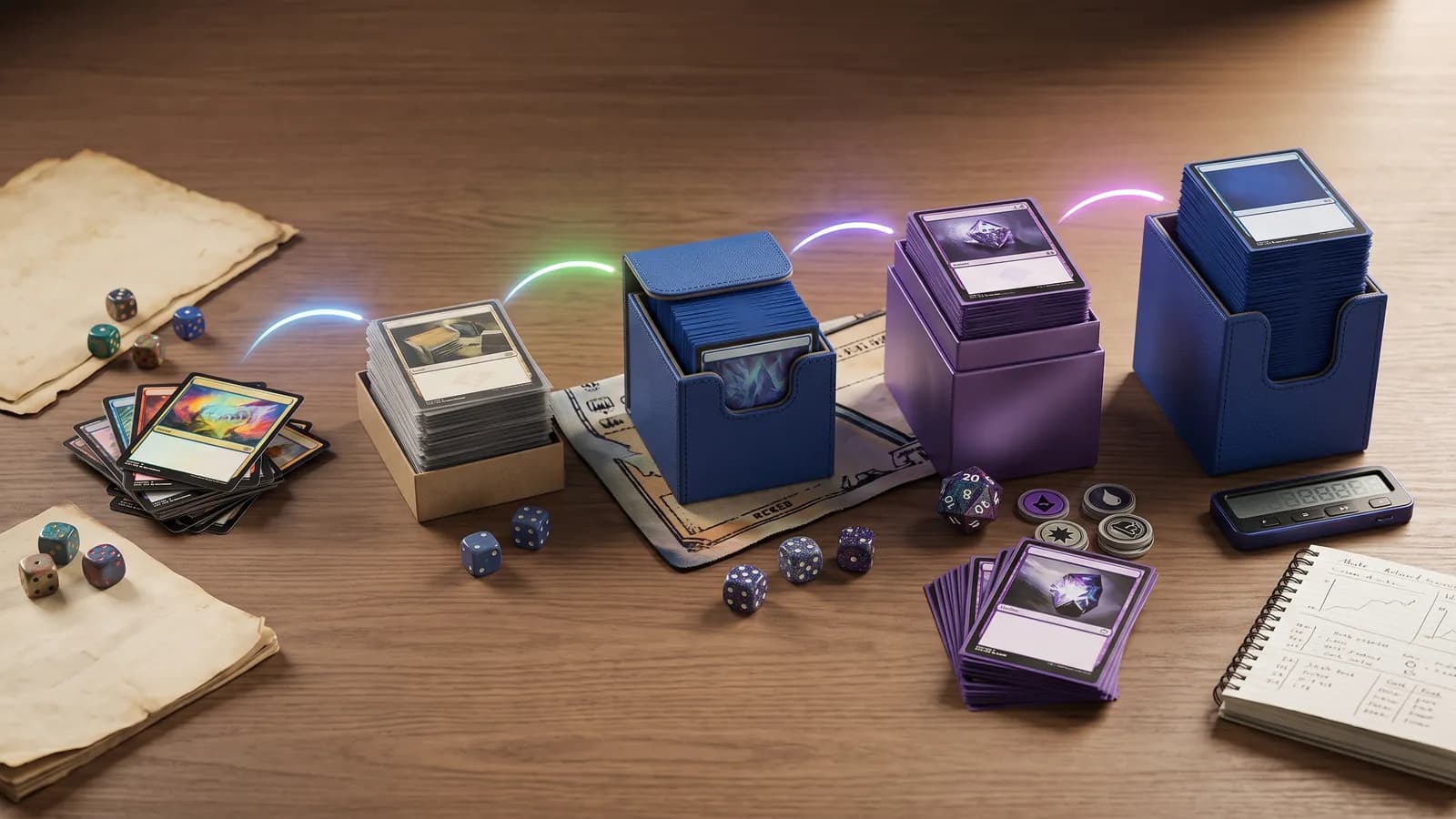
Commander Brackets are Wizards of the Coast's optional framework for discussing the kind of game a deck is built to play. There are five brackets, from Exhibition to cEDH. They are not official ratings awarded to individual decks, and a calculator cannot certify one.
The current Wizards Commander page describes the system as optional and still in beta. Use the bracket descriptions, deck contents, and your group's expectations together.
Why brackets exist
Commander has a large card pool and many ways to enjoy a game. Two decks can have similar budgets or share a commander while aiming for very different experiences.
A bracket is a starting point for that conversation, not a guarantee of an even match. In its February 2026 update, Wizards explicitly says adjacent brackets can still have good games when players agree on expectations.
Bracket 1 — Exhibition
Theme and expression come before efficiency. Players should have time to show what their decks do; Wizards' general expectation is at least nine turns before winning or losing.
The default excludes Game Changers, but this is also where an explicit pregame agreement about unusual commanders, card legality, or a thematic exception is particularly relevant. An exception requires the table's agreement, not a label assigned by a tool.
Bracket 2 — Core
Core means straightforward, unoptimized play with incremental, visible, disruptable win conditions and a social emphasis. The general expectation is at least eight turns before winning or losing. The default excludes Game Changers and game-ending combos.
A precon is not automatically Bracket 2. Wizards removed that association in October 2025 because preconstructed decks vary. Inspect the actual list and intended play pattern before upgrading a precon or choosing a table.
Bracket 3 — Upgraded
Upgraded decks have strong synergy, effective interaction, and higher card quality. They allow up to three Game Changers in the whole deck, including a commander on the list. Three is a cap, not a requirement or an automatic classification.
Wizards expects at least six turns of play before winning or losing. Its October explanation specifically uses a win on someone's seventh turn as the example. This describes the intended experience, not permission to build an early combo deck and hold the combo until a later turn.
Bracket 4 — Optimized
Optimized decks aim for fast, consistent, efficient wins without necessarily being built for the cEDH metagame. There is no Game Changer cap, but the normal Commander banned list and deckbuilding rules still apply.
The general expectation is at least four turns before winning or losing. Read Bracket 3 vs. Bracket 4 for the distinction between a powered-up social deck and a list designed for an explosive high-power game.
Bracket 5 — cEDH
Competitive EDH is built and played for the cEDH metagame, prioritizing victory, efficiency, and consistency. Games can end on any turn.
It is not simply “Bracket 4 with more expensive cards.” The difference is competitive intent and metagame preparation; see cEDH vs. Optimized.
How to estimate your deck's bracket
- Check the current Game Changers list and the normal Commander rules.
- Count listed cards throughout the deck, including commanders.
- Consider how the deck usually wins, its tutors and interaction, and how early its plan is reliably available.
- Compare the intended experience with the bracket descriptions, then discuss it with the table.
The turn expectations above come from Wizards' October update. They are not measured average game lengths or automatic verdicts based on one unusually strong draw.
The Blue Core deck analyzer provides an independent estimate and flags signals in the imported list. It does not issue a Wizards-approved rating and cannot determine player intent or fully represent every interaction. Review its output using the methodology, your actual games, and the Rule Zero conversation.
The useful question is not “can a number prove my deck belongs here?” It is “does this deck produce the game this table wants?”