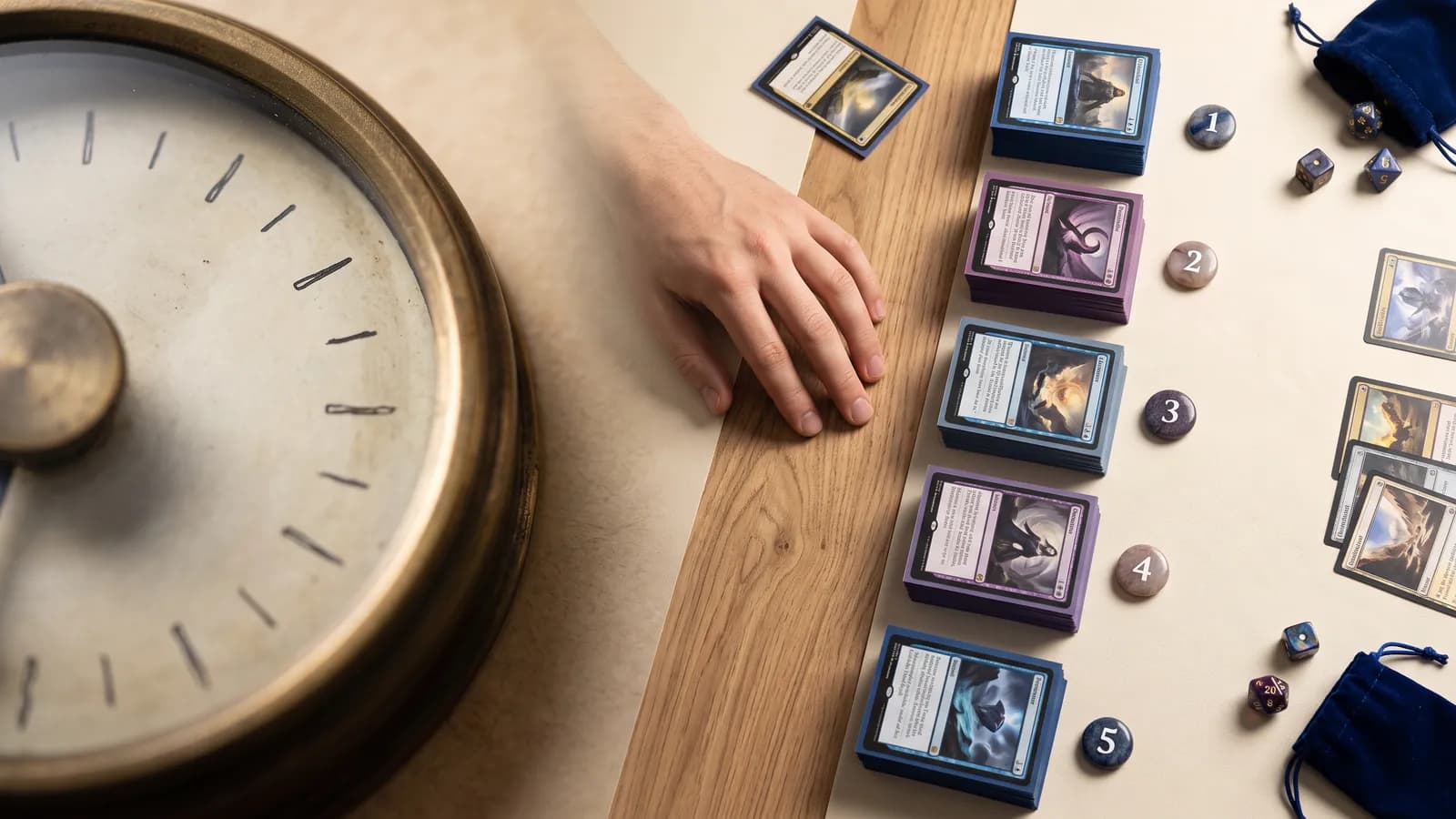
For years, the pregame power-level conversation in Commander went something like this: "My deck's about a seven." "Mine's more like a six and a half." "Cool." Then someone would run a turn-four combo and the table would quietly seethe. The 1–10 scale meant something different to everyone who used it — and that was always the problem.
Where the 1–10 scale came from
The informal 1–10 system wasn't invented by Wizards. It grew out of the Commander community itself, popularized in large part by content creators — most notably The Command Zone podcast, which laid out a ten-point rubric roughly mapping "jank," "casual," "focused," "optimized," and "competitive" onto pairs of numbers. The framework spread fast because it gave players something to say before a game. Even a vague number felt better than nothing.
At its best, the scale got two strangers roughly aligned. At its worst — which was often — it produced the opposite. Players routinely rated their own decks a full bracket lower than they actually performed, because the scale had no anchor points everyone agreed on. "A seven" in one local game store meant a turn-five win with consistent protection. "A seven" across town meant a pile of draft chaff with a good commander. The word "seven" had become a social signal ("I'm not trying too hard") more than a measurement.
Why the number problem got worse over time
The bigger the Commander card pool grew, the harder it became to compare decks on a single axis. A deck can have a mediocre commander but explosive ramp. It can run every powerful tutor but no reliable win condition. A "five" built in 2019 looks completely different from a "five" built in 2024, because the preconstructed baseline shifted dramatically upward. The 1–10 scale had no mechanism to account for any of this — it just asked each player to self-report a vibe.
The result was predictable: the middle of the scale collapsed into a single number. Surveys of Commander players consistently showed the majority of people rating their decks between six and eight, regardless of what those decks actually did. You could have a pod of four "sevens" that ranged from someone's janky pet project to someone's well-tuned midrange storm build. The conversation was happening; it just wasn't communicating anything.
What WotC did differently in 2025
In February 2025, Wizards of the Coast took over management of the Commander format from the long-running Rules Committee and formed a new Commander Format Panel — seventeen people drawn from the wider community. One of their first moves was to replace the 1–10 scale with something that could actually be verified.
The five-bracket system they introduced is structured around specific deckbuilding behaviors rather than a player's subjective impression. The brackets run from Bracket 1 (Exhibition) through Bracket 5 (cEDH), and they're anchored to expected game lengths: Exhibition games run nine-plus turns, Core games eight-plus, Upgraded games six-plus, Optimized games four-plus, and cEDH has no turn floor. Those anchors give the system its teeth — it's not asking you to feel how powerful your deck is, it's asking what your deck actually does.
The central mechanism is the Game Changers list: roughly fifty-three cards whose presence in a deck forces a minimum bracket rating. Cards like Demonic Tutor, Cyclonic Rift, Rhystic Study, and Thassa's Oracle are on it. Notably, Sol Ring is not on the Game Changers list — Wizards considers it too embedded in Commander culture to restrict at lower brackets. And Mana Crypt and Jeweled Lotus aren't Game Changers either, for a different reason: they're banned outright.
How the brackets evolved through 2025
The system launched in beta and has been updated several times since. The tutor-count restriction — which originally told Bracket 1–3 players to use "few" tutors — was removed entirely in the October 2025 update. The panel concluded that the language was too vague and that the Game Changers list already handled the most powerful tutors directly. That same update trimmed ten cards from the Game Changers list, including Winota, Kinnan, and Yuriko, which the panel felt were being overcounted relative to their actual table impact.
The February 2026 update added Farewell and Biorhythm (the latter following its unban) and clarified the Game Changers to a stable fifty-three. The panel signaled they were done making rapid changes — the system needed time to settle before more tweaking.
What the brackets actually fixed
The biggest improvement isn't the five labels themselves. It's that the system makes third-party verification possible. You're no longer relying entirely on a player's self-assessment. Paste a decklist into a tool like the deck analyzer and it will check every card against the Game Changers list, apply the bracket rules, and tell you the result — with a card-by-card breakdown of what earned the rating.
This matters because the old 1–10 problem wasn't dishonesty. Most players who said "it's a seven" genuinely believed it. The problem was that humans are bad at rating their own decks — systematically biased toward underestimating power level, especially for decks they built themselves. Externalizing the check removes that bias.
The brackets also do something the 1–10 scale never could: they define a floor. If your deck contains three Game Changers, it is at minimum a Bracket 3, no matter how the rest of the list looks. "My deck is only a six, the combo is in there but I never really use it" doesn't work under the new system. The combo is in the deck. The bracket follows.
What the brackets didn't fix
The brackets are not a complete solution and Wizards never claimed they were. The rule zero conversation still needs to happen — brackets describe deckbuilding, not play patterns. A turbo-stax Bracket 3 deck can make games deeply unpleasant for everyone at the table while still technically landing in the right bracket. A Bracket 4 player who draws poorly for six games in a row isn't actually playing at Bracket 4 in any meaningful sense.
There's also a long tail of cards that don't appear on the Game Changers list but are still powerful enough to punch above their bracket. The panel can't maintain a list long enough to catch everything; the Game Changers list is explicitly not an exhaustive ranking of the most powerful cards in Commander.
What the brackets are is a shared reference point — something the 1–10 scale tried and failed to be. Two players who have never met before can look at the same list, check it against the same rules, and get the same answer. That's not nothing. That's actually quite a lot.
Making the most of both systems
The 1–10 scale isn't dead. You'll still hear it, especially from players who haven't updated their vocabulary yet, and it still communicates something in contexts where everyone at the table shares the same reference frame. If you know your playgroup well, "I'm running something closer to an eight tonight" can land perfectly fine.
But when you're sitting down with strangers — at an LGS, a MagicCon, or a pick-up game at a convention — brackets give you a language that travels. Check your deck against the methodology before you sit down, know your bracket, say it out loud. You'll spend thirty seconds on the pregame conversation instead of five minutes and still start the game with better information.
The 1–10 scale was the community's best attempt at solving a real problem. The brackets are the current best answer — and unlike a number that means whatever the speaker thinks it means, a bracket is something you can actually check.