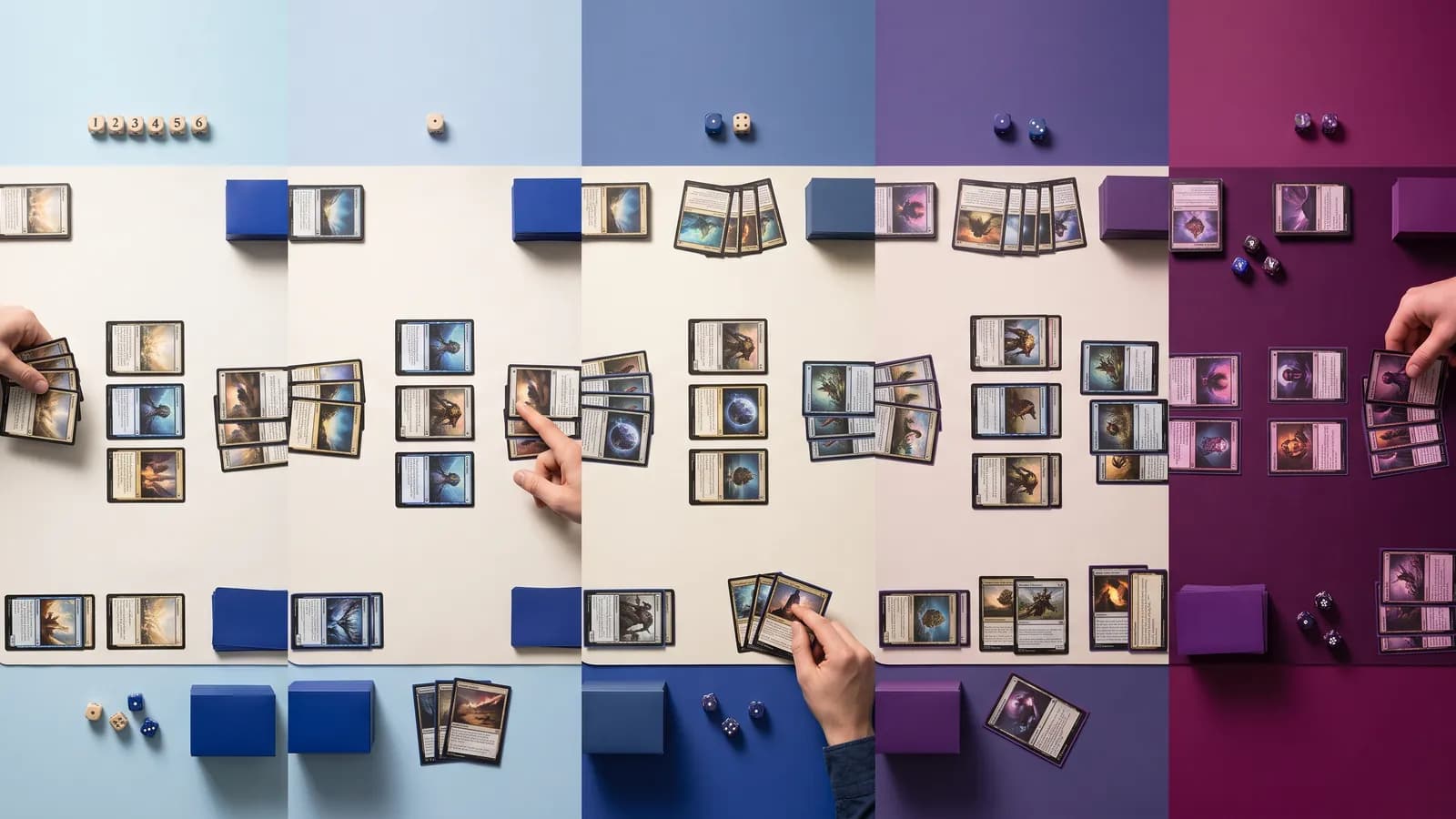
Ask someone what bracket their deck is and they'll say a number. Ask them how long their games last and they'll tell you the truth. Turn count is the clearest signal of power level in Commander — not the card names, not the dollar value, not how scary the commander looks on the card. The bracket system recognised this and built expected game length directly into each tier. Understanding why turns map onto brackets the way they do makes the whole system click.
The official anchors
The five brackets are each pinned to a minimum expected game length:
- Bracket 1 (Exhibition): turn 9 or later
- Bracket 2 (Core): turn 8 or later
- Bracket 3 (Upgraded): turn 6 or later
- Bracket 4 (Optimized): turn 4 or later
- Bracket 5 (cEDH): any turn — in practice, turns 3–7 on average
These aren't targets. They're floors — the earliest point where ending the game starts to feel fair at that bracket. A Bracket 1 game that wraps on turn 11 is fine. A Bracket 2 game that ends on turn 4 is not.
Why Brackets 1 and 2 play long
Exhibition and Core decks lack the tools to close out a game quickly, and that's the point. No Game Changers are allowed in either bracket — so the highly efficient tutors, mana doublers, and game-ending combo enablers that compress win conditions into a few turns simply aren't there.
Bracket 1 is the theme deck bracket. You're playing a landfall tribal or a voltron commander who takes forever to connect. Turns stretch because the whole deck is built around the journey, not the destination. Bracket 2 is where modern preconstructed decks live — cleaner curves, more focused game plans, but still deliberately paced. The mana acceleration is gentle and the wins come from card advantage accumulating over several turns rather than from a compact combo line.
Long games aren't a bug here. They're how these brackets stay accessible to newer players and casual tables. Enough time passes for everyone to draw into their fun cards, try their synergies, and not feel cheated by a turn-four wipe they couldn't interact with.
Bracket 3 tightens the window
The Upgraded bracket introduces Game Changers — up to three per deck. That cap is doing a lot of work. A single Demonic Tutor or Rhystic Study can meaningfully accelerate or extend a game plan, but three well-chosen Game Changers mean a Bracket 3 deck can find its win condition more reliably and execute it faster than a precon ever could.
The floor shifts to turn 6, and that's felt across a whole game. Decks start doing something threatening in the early turns rather than just ramping and drawing. Combos exist in Bracket 3, but they're usually assembled mid-to-late game and require several pieces coming together. The table has time to see it coming and react — if they've got the right cards.
This is the bracket where consistency starts mattering more than raw power. A tuned Bracket 3 deck isn't necessarily running more expensive or more dangerous individual cards than a Bracket 2 deck; it's just finding and executing its plan more reliably, which is what shaves those two turns off the expected game length.
Bracket 4 changes the equation
Once you hit Optimized, the rulebook looks different. There's no cap on Game Changers, no restriction on tutor density, and no ceiling on how fast your mana can get. The expected game length drops to turn 4 or later — meaning the table genuinely expects someone could win on turn 4, even if most games run a bit longer.
The practical difference from Bracket 3 isn't just that decks are more powerful. It's that the deck is trying to win as early as it reasonably can, every game. That's a different design philosophy. A Bracket 4 list is built to maximise consistency in reaching its win condition fast — and it has the tutors, fast mana, and combo density to back that up.
This is why the Bracket 3 vs. Bracket 4 line is the one people argue about most. A deck that sometimes wins on turn 5 or 6 might be either bracket depending on why it's winning that fast: is it because the stars aligned, or because the deck was built to make that happen reliably? The former is Bracket 3. The latter is Bracket 4.
cEDH is a different game
Bracket 5 doesn't name a floor — it can end on any turn. In practice, cEDH games average somewhere around turn 4–5, with plenty ending on turn 3 and plenty going longer when interaction gets heavy. What separates cEDH from Optimized isn't really the turn count; it's the metagame context.
A cEDH deck isn't built around your favourite commander or a pet strategy pushed to its limit. It's built to win against other cEDH decks doing the same thing, right now, in the current tournament metagame. The decks are packed with free interaction — counterspells that cost no mana, responses that can fire at instant speed — because every turn is a race and losing priority at the wrong moment ends the game.
The speed exists because of the density of interaction, not in spite of it. Games move fast because everyone is trying to either win or stop everyone else from winning as efficiently as possible. A Bracket 4 deck dropped into a cEDH pod will usually lose, and feel it immediately — not because its cards are bad, but because it's playing a slower game at a table where turns 3–5 are already high-stakes.
What this means when you're building a deck
The turn-count anchors give you a concrete target, which is more useful than "how powerful does this feel?" When you're trying to land your deck in a specific bracket, think about your earliest realistic win. Not your fastest possible win with a perfect hand — your typical win with a reasonable hand.
If your deck can regularly assemble its win condition by turn 5 or 6, it's probably not Bracket 2 no matter how many basics you're running. If your deck has never ended a game before turn 8, you almost certainly don't have Bracket 4 cards in it. The outliers exist, but they're outliers.
The other thing to watch is whether your early turns are threatening or neutral. A Bracket 1 or 2 deck spends turns 1–3 playing mana and setup pieces that don't pressure the table. A Bracket 3 deck might be establishing something opponents need to answer by turn 3 or 4. A Bracket 4 deck is often actively setting up a kill in those same turns. That shift in what the early game looks like is what the table feels across from you — and it's why the turn-count anchor maps so closely onto the social contract each bracket is supposed to carry.
Check your deck, not your gut
People consistently underestimate their own decks by a bracket or so. It's not dishonesty — it's that you know how your deck feels to pilot, not how it feels to play against. The turn-count lens helps: if someone at your table is done on turn 5 every couple of games, the pod is probably not Bracket 2, whatever everyone called it in the pregame.
The fastest way to get an honest answer is to paste your list into the deck analyzer. It returns your official bracket with a card-by-card breakdown — including exactly which cards are pulling your expected game length down. If you want to understand the thresholds behind the call, the methodology page lays out every rule we check and why.
Brackets are only useful if they're honest. The turn count is the best gut-check you have.