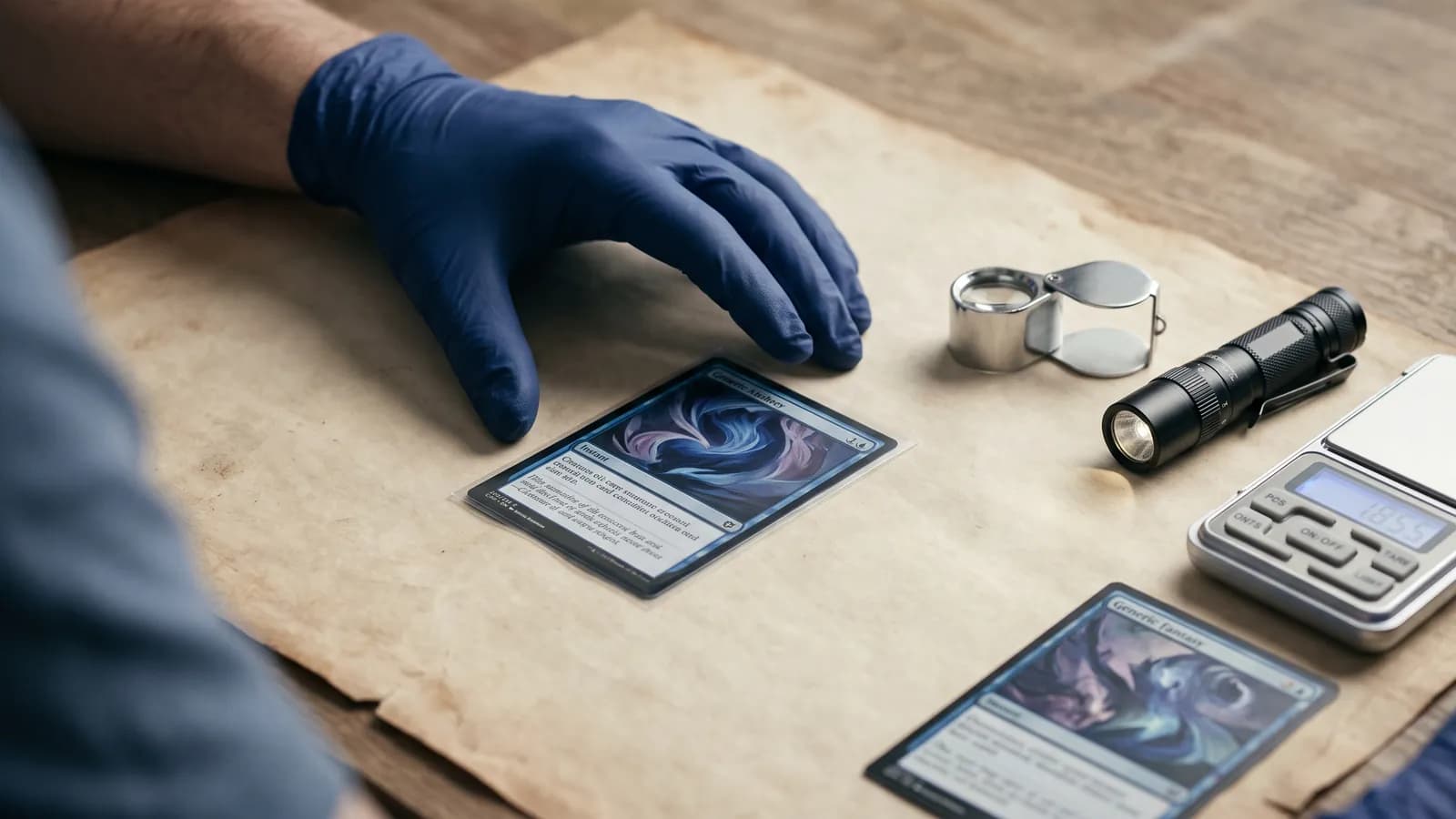
Pick up any guide written before 2020 and the bend test gets glowing reviews: flex the card gently between your fingers, feel for the snap-back, and if it springs back true you're holding a real Magic card. The logic made sense at the time. It doesn't hold up anymore — and if you use it on the wrong card you might destroy the real thing you were trying to protect.
What the bend test was actually checking
The test has always been a feel check, not a science. Genuine Magic cards are printed on proprietary card stock with a blue-tinted inner core layer sandwiched between two paper faces. That layered construction gives authentic cards their characteristic snap and rigidity — bend them and they push back. The idea was that cheap counterfeit stock wouldn't replicate that feel, so a limp card or one that creased instead of springing back was automatically suspect.
For a few years, that logic caught things. Low-end fakes from the early 2010s often used inferior stock that felt immediately wrong. You'd flex the card, it would stay bent or crease rather than returning flat, and you'd know.
The problem is that counterfeiting operations did not stand still.
Why it fails on modern fakes
The better counterfeit operations in 2025 and 2026 source their paper more carefully. Modern high-end fakes use card stock that incorporates its own graphite or binding layer — the same structural element that gives genuine cards their snap. The result is a fake that bends and returns convincingly, making the test effectively useless as a standalone screen.
There's also a second failure mode that people don't talk about enough: the test can destroy a real card. Foils are the obvious case — never bend a foil, ever, for any reason, because the metallic layer creases permanently and the damage is irreversible. But standard non-foil cards can also be harmed if you bend them the wrong way or too sharply. A crease in a $200 card from a legitimate set because you were trying to verify it is not a good outcome.
The deeper issue is that the bend test gives you a feeling of certainty without earning it. A fake that passes still feels like a win. You flex it, it snaps back, you relax — and the counterfeit goes into your deck.
The tests that actually work
Rather than asking "does this feel right," ask the card to show you something it can't fake:
The light test is still the most reliable first check for non-foil cards. Press your phone's flashlight against the back of the card in a dim room and look through the front. A genuine card glows with a faint bluish tint from its inner core layer. Most fakes either blaze too brightly — the stock lets too much light through — or go nearly dark with a grey-brown tone, not blue. It takes about three seconds and you're not touching the card aggressively. Full detail at /methods/light-test.
The rosette print test is close to definitive, especially for high-value cards. Under a 10x loupe, genuine cards printed by Cartamundi show the classic rosette dot pattern of CMYK offset printing — tiny dots arranged in clean, circular clusters. More importantly, black text and borders on real cards show a fifth-pass overprint layer that keeps the lines razor-sharp. Most counterfeit operations don't run five printer units, so their blacks look slightly fuzzy or the dot structure under magnification is irregular. A loupe costs less than most singles you'd want to authenticate. See /methods/rosette-print-test for what to look for.
The back comparison is low-tech and surprisingly effective: lay the card next to a Magic card you know is real. Fakes almost always get the brown tone or the pattern sharpness subtly wrong, and side by side it jumps out in a way it wouldn't if you were looking at the suspect card alone.
What about the rip test and UV?
The rip test has the same problem as the bend test, compounded: it's destructive, it can give false results (Wizards has used black-core stock in some legitimate products), and any information you get from it could have been obtained non-destructively first. If you've run the light test and the loupe test and you're still uncertain, you should be consulting a professional opinion — not tearing the card.
UV/black light tests are weak. Some real cards don't fluoresce the way the test expects; some fakes fluoresce fine. It's background noise compared to what a loupe tells you.
If you already own a card you're unsure about
Don't bend it. Run the light test. If anything looks wrong, get a loupe and check the print pattern. If it's valuable enough that you're worried, check it against the /blog/buying-reserved-list-cards-safely guide before doing anything that could damage it.
And if you bought it on Cardmarket, eBay, or TCGplayer and it turns out to be fake — open a buyer-protection claim immediately. All three platforms treat counterfeit as "item not as described" and the claim is nearly always upheld, but the clock starts from when you received the card.
The one thing the bend test still tells you
There is exactly one scenario where flexing a card still has some value: checking for rebacks — a genuine card face glued onto a different card's back, or onto a blank. A reback often has visible crease lines on the inner face when you flex it, because the glue and paper layers don't move together cleanly. But this is a narrow, specific use case, and even then it's a secondary check after the light test and loupe, not a substitute for them.
For everything else — any card you're buying, any card that arrives in the mail, any card you're not certain about — skip the bend test. It's not that it never worked; it's that the fakes it was designed to catch got better while the test stayed the same.