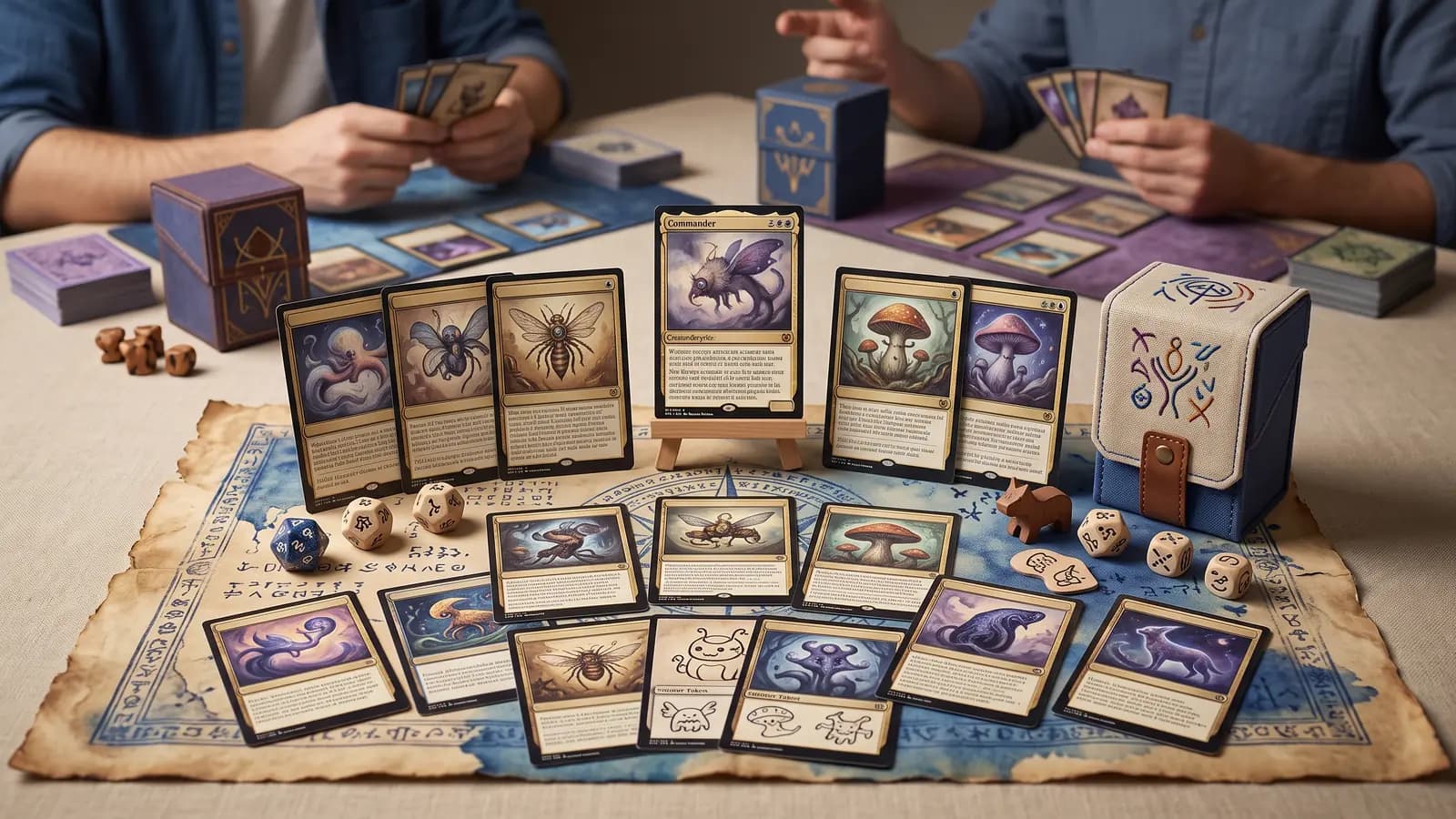
Bracket 1 exists for one reason: to let you build the deck that no one asked for. Maybe it's every card with a frog in the art. Maybe it's the Weatherlight Crew, all forty of them, in a ship-tribal deck that has no interest in winning quickly. Whatever the idea is, Exhibition — the official name for Bracket 1 in the WotC five-bracket system — is the space carved out for it.
What "Exhibition" actually means
The bracket name isn't an accident. You're showing something off. The deck is the point, not the finish line — and the rules are written to protect that experience for everyone at the table.
Concretely, a Bracket 1 deck must avoid all four of these things:
- Game Changers — none, zero, not even one that "fits the theme perfectly" (though you can table that exception in a pregame conversation and everyone agrees)
- Mass land denial — no Armageddon, no Ravages of War, nothing that strips multiple players of their mana base
- Extra-turn chains — a single Time Warp might technically slide in, but chaining them is out
- Two-card infinite combos — no fast, self-contained lock that ends things before anyone had a chance to enjoy their spells
Games are supposed to last at least nine turns. That's by design. The slower pace is what lets everyone's weird build actually do its thing.
The intent rule — and why it matters more here
One thing the bracket system got right in the October 2025 update: they stopped pretending that a checklist can fully capture what makes a deck fit a bracket. For Exhibition specifically, intent is the defining characteristic.
A deck isn't Bracket 1 because it's weak. It's Bracket 1 because it was built to showcase something. A powerful commander running a deep thematic restriction — only cards from Theros, only art by Rebecca Guay, only creatures with exactly three toughness — can be a perfect Exhibition deck even if a few individual cards look efficient on paper.
This also means Exhibition is the bracket where the pregame conversation carries the most weight. If your deck does something genuinely unusual — Un-cards, cards from a set that rotated out, or a Game Changer that is so on-theme you can't imagine the deck without it — say so before you shuffle. Bracket 1 is the one place where the whole table is basically expecting that kind of disclosure.
What tutors do (and don't do) here
As of the October 2025 rule update, the bracket system dropped its tutor-count restriction entirely. The old guidance around "few tutors" was vague and inconsistently applied, so it was cut.
Practically speaking, for Bracket 1 this changes less than you'd think. If you're filling every available slot with Demonic Tutor and Vampiric Tutor, you're not really building an Exhibition deck — you're building a deck that pretends to be one. The bracket system leans on the Game Changers list to flag the most powerful tutors. The ones that aren't on the list (Diabolic Tutor, Scheming Symmetry, and similar fair-ish options) are fine in any bracket, including here.
Building an Exhibition deck that actually works
The challenge is that "no restrictions on cards" and "no desire to win" can produce a deck that just flops around and stops being fun for you as the pilot, too. A few principles that help:
Pick one real constraint and commit. "I want a fun deck" is too vague. "Every card must have a snake in the artwork" or "every nonland card was printed before 2010" gives you a genuine deckbuilding puzzle. The constraint is what makes the deck interesting to build and to play.
Let the commander earn its spot. In most brackets the commander is a win condition. Here, it's a focal point. Choose one that enables your theme or celebrates it — something that would feel weird outside the specific deck you're building.
Cut efficient staples deliberately. Sol Ring is technically not a Game Changer and is legal in every bracket, but dropping it from a Bracket 1 deck is often the right call. Three- and four-mana ramp that fits your theme will slow the deck down in a way that keeps games in that nine-turn window. The slower pace isn't a bug.
Plan a couple of actual win conditions anyway. You're not trying to win fast, but the game has to end eventually. A single big threat or a grindy value engine is enough. Just don't engineer something that can close the game on turn three — the whole table came to play, not to watch.
Some directions that work well
A few archetypes land naturally in Exhibition without feeling half-baked:
Tribal with a twist. Pure tribal (all Merfolk, all Goblins) usually lives in Bracket 2. But weird tribal — chair tribal, food tribal, all creatures that are also wizards who happened to be printed on silver-bordered cards — that's Bracket 1 territory. The restriction is the point.
Plane or set restriction. Build with cards only from Ravnica, or only from Innistrad blocks, or only Dominaria printings. You're evoking a place and a period. These decks tell a story every time something gets cast.
Artist-tribal. Every card illustrated by the same artist. Kev Walker has enough cards to make this viable; Jesper Ejsing or Terese Nielsen will make you work for it. The visual coherence is immediately obvious when you lay cards out.
Secret commander. Build the deck entirely around a card in the 99 — Sunforger, Sanguine Bond, that one janky enchantment you've loved since 2007 — and choose a commander that just enables it. The commander becomes a supporting actor.
The pregame ask
When you sit down at a table with a Bracket 1 deck, a ten-second heads-up goes a long way: "Hey, this is an Exhibition deck — frog art, mostly junk, games will go long." That's it. Anyone who wants a faster or more competitive game knows to say so now rather than twelve turns in.
If you're on the other side and someone else announces Exhibition, adjust your expectations accordingly. Don't goldfish your Bracket 3 deck at full speed against them — nobody has fun when the power gap is that wide. If your whole group is playing Bracket 1, that context should come out in the rule zero conversation before anyone shuffles up.
How the analyzer handles it
The bracket analyzer reads your decklist and flags Game Changers, checks for the conditions that push a deck out of Bracket 1, and returns a bracket assignment. For Exhibition-range decks, the more relevant output is usually the card-by-card breakdown: seeing exactly which cards would push you into Bracket 2 if you swapped them in is useful for tightening a themed build.
Paste your list into the analyzer and look at what it does and doesn't flag. If a card you love shows up as a concern, that's information — either swap it out or have the conversation at the table before you play.
Exhibition isn't the weakest bracket because nobody cared enough to tune it up. It's the weakest bracket because someone decided that a deck about frogs is worth building for its own sake. The bracket system just gives that decision a name.